
Middle East Press On: Italy, Turkey, NATO’s Southern Flank, Iran, UAE, Israeli Army, US-Iran, Strait of Hormuz, Trump Became ‘Hostage’ To Israel Over Iran War, New Age Islam's Selection, 06 May 2026

By New Age Islam Edit Desk
06 May 2026
Italy and Türkiye: Forging a new pillar of NATO’s southern flank
Iran denies attacking UAE, warns of ‘decisive response’ if strikes launched from its territory
Israeli army chief, air force commanders acknowledge October 2023 failure
Only a win-win formula can break US-Iran gridlock
Iran will hurt itself with Strait of Hormuz power play
Iran between fragmentation and change
Tucker Carlson Says Trump Became ‘Hostage’ to Israel over Iran War – NYT
------
Italy and Türkiye: Forging a new pillar of NATO’s southern flank
BY VALERIA GIANNOTTA
MAY 06, 2026
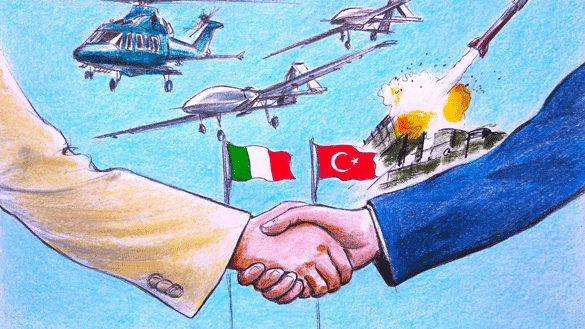
The relations between Italy and Türkiye are further cementing. From merely a bilateral level defined by many complementarities, shared NATO membership and common interests in Mediterranean stability the ties have been elevated into something far more structural: a genuine defense industrial partnership, underpinned by high-level diplomacy, interlocking military visits and technology transfers that are already reshaping mutual air power, naval aviation and missile defense. One year after the 4th Italian-Turkish intergovernmental summit held in Rome, where important agreements were signed, the partnership has further strengthened and the rhythm of bilateral visits continued at all levels, including the military.
Recently, Italy’s Army Chief of Staff General Carmine Masiello made his own visit to Ankara for bilateral talks, signaling that the Rome-Ankara channel is firmly embedded in industry and in their operational and strategic thinking. Italy’s military-technical interest in Turkish capabilities indeed is not something; however, the convergences are now gaining momentum. The ambitions are very vivid and interesting developments are recorded in different sectors.
TB3 integration
Among the others, the focus is currently on the Italian Navy's carrier aviation. In March 2026, the Italian Navy chief of staff, Vice Adm. Giuseppe Berutti Bergotto, confirmed in his statement in Parliament that the Baykar TB3 unmanned combat aerial vehicle (UCAV) could be integrated aboard the aircraft carrier ITS Cavour by enabling both surveillance missions and the possibility of carrying armament. On the other side, Baykar CEO Haluk Bayraktar affirmed that a formal Italian acquisition is projected for the third quarter of 2026 and that this move would make Italy the first European operator of the carrier-capable TB3.
As a matter of fact, the operational proof of this concept had arrived during NATO's Steadfast Dart 2026 exercise in the Baltic Sea in February 2026, when, for the first time in European history, the TB3 operating from Türkiye's TCG Anadolu took off from an aircraft carrier, conducted a strike mission and returned to the ship.
As the Italy-Türkiye industrial framework is already functioning well overall, along with Leonardo-Baykar LBA Systems, from the Italian perspective, the integration of the TB3 program could enable national control over mission systems and NATO-oriented integration pathways. However, the emerging partnership in air and missile defense is also noteworthy. As recently reported, Türkiye had opened a new round of negotiations with Italy to acquire and co-produce the SAMP/T air and missile defense system, the Franco-Italian long-range interceptor produced by the Eurosam consortium.
Urgency for NATO
Due to the regional and international conjuncture, the issue is quite urgent. Indeed, NATO forces had already intercepted four Iranian missiles launched toward Türkiye since the start of the U.S.-Israeli war on Iran, exposing some gaps in long-range air defense coverage on the alliance's southeastern flank. Furthermore, the SAMP/T may be perceived as a central pillar of Türkiye's "Steel Dome" layered missile shield.
Critically, France has historically blocked progress over some political stances and objections, while Italy has maintained genuine support for the trilateral cooperation and it does not object to the joint co-production. Given the longstanding bilateral strategic complementarities, Rome’s consistent support for Ankara as a key actor in the Eurosam framework has helped make Italy Türkiye's most reliable European interlocutor in the air defense industry, carrying real strategic weight within NATO.
In a wider perspective, Italy and Türkiye are mutually reinforcing investment across multiple platforms. Together with Spain, Rome and Ankara are collaborating on T625 Gökbey helicopter manufacturing through partnerships involving the Turkish companies Turkish Aerospace Industries (TAI), TUSAŞ Engine Industries (TEI) and Aselsan, along with Spanish CESA and Italian Avio Aero. On the other hand, Türkiye is engaged in negotiations to purchase 40 Eurofighter Typhoon jets, which is a consortium including Italy's Leonardo.
Those moves are of great significance as they would embed Ankara more deeply into Europe's collective defense architecture. Likely, in a highly fragmented international system, bilateral deals underpin the multilateral decision-making as they are faster and more flexible in pragmatically sealing partnerships and affinities, overall regarding middle powers. In this way, also from the EU common defense perspective, by engaging directly, Italy and Türkiye can overcome the stalemate related to EU bureaucracy. Pivoting on the same values, approaches and perceptions, Rome and Ankara share the same expectations for the next NATO summit to be held on July 7 and 8 in Ankara.
It will be the first time Türkiye hosts allied leaders since the 2004 Istanbul summit, and it comes at a moment of profound stress for the alliance due to the ongoing Russia-Ukraine war and escalating tensions in the Middle East, along with a dramatic shift in U.S. policy that is straining trans-Atlantic cohesion and defense commitments. For Türkiye, as NATO's second-largest army, a key actor in the defense of the alliance’s southern flank with an innovative military industry, hosting this summit is indeed more than a statement. Despite the challenges, for Italy, the Ankara summit offers a moment to consolidate its role as Türkiye's closest European defense partner with whom it shares the same responsibility in terms of regional security guarantor. At any level and in any strategic area, Rome and Ankara are working out the architecture of the alliance's southeastern shield. Thus, the Rome-Ankara axis is now more important than ever and beyond any aspiration, it has become an operational reality.
https://www.dailysabah.com/opinion/op-ed/italy-and-turkiye-forging-a-new-pillar-of-natos-southern-flank
-----
Iran denies attacking UAE, warns of ‘decisive response’ if strikes launched from its territory
May 5, 2026
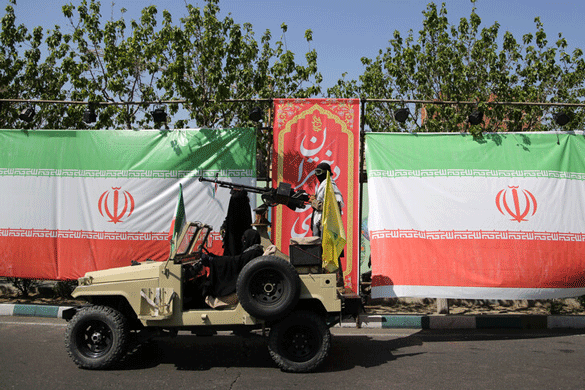
Iran’s armed forces denied carrying out any missile or drone attacks against the United Arab Emirates in recent days, Iranian state media IRIB reported Tuesday.
IRIB, citing a statement by a spokesman for Iran’s Khatam al-Anbiya Central Headquarters, said no such operations had been conducted, adding that any action would have been “clearly and officially announced.”
The spokesman also rejected accusations by the UAE Defense Ministry as “baseless.”
He warned that if any attack against Iran originates from the UAE territory, Tehran would respond with a “decisive and regret-inducing” retaliation.
He also accused the UAE of allowing US and Israeli forces to operate from its territory, urging Emirati authorities not to become a base for what he described as hostile powers.
The warning comes amid heightened tensions in the Gulf, including a second consecutive day of reported strikes targeting the UAE.
Authorities in the UAE said air defenses intercepted waves of missiles, cruise missiles and drones launched from Iran, with an earlier attack causing a major fire at the Fujairah Oil Industry Zone.
Regional tensions have escalated since the United States and Israel launched strikes on Iran on Feb. 28, triggering retaliation from Tehran and disruptions in the Strait of Hormuz.
A ceasefire took effect on April 8 through Pakistani mediation, but talks in Islamabad failed to produce a lasting agreement. The truce was later extended by US President Donald Trump without a set deadline.
Since April 13, the United States has enforced a naval blockade targeting Iranian maritime traffic in the strategic waterway.
https://www.middleeastmonitor.com/20260505-iran-denies-attacking-uae-warns-of-decisive-response-if-strikes-launched-from-its-territory/
------
Israeli army chief, air force commanders acknowledge October 2023 failure
May 5, 2026
Israeli Chief of Staff Eyal Zamir and the outgoing and new air force commanders acknowledged Tuesday that the military failed during the Oct. 7, 2023 events.
The remarks came during a handover ceremony at Tel Nof Airbase in central Israel, where outgoing air force chief Tomer Bar transferred command to his successor Omer Tishler, according to the Yedioth Ahronoth daily and Channel 12.
“On Oct. 7, this branch — like the entire Israeli military — failed in its mission to defend the state of Israel,” Zamir said. “This failure accompanies us daily and obliges us to take responsibility and investigate it.”
Israeli officials consider what happened on Oct. 7, 2023 to be the biggest Israeli intelligence and military failure, which has caused great damage to the image of Israel and its army in the world.
Bar said the full picture of what happened would only emerge after an independent external inquiry.
“Oct. 7 was the greatest catastrophe we have faced since the Holocaust and I will forever carry with me the profound meaning of this day,” he said. “We were not there for the civilians. It happened on my watch while the Air Force operations were my responsibility.”
He acknowledged that “the entire Israeli military failed that morning,” noting that “for the first time the air force was tasked with defending civilians while fighting unfolded inside Israeli territory.”
Bar stressed the need for “an external and objective commission of inquiry,” saying it was essential for the military, security institutions and public trust.
Israel’s opposition has repeatedly called for an independent state commission of inquiry appointed by the Supreme Court, while the government of Benjamin Netanyahu has pushed for a political panel instead.
In December, a ministerial committee approved forming a government-appointed inquiry, drawing criticism from opposition leaders who said it would lack independence.
Netanyahu said at the time that his government would determine the committee’s mandate and the limits of the investigation.
Tishler, for his part, described the events as a “bitter military failure,” pledging to implement all the lessons of the Oct. 7 investigations.
“We will not allow enemies to build up on our borders,” he said.
Tishler added that the air force is tracking developments involving Iran and “ready to deploy its full capabilities eastward if necessary.”
Regional tensions have escalated after the US and Israel launched strikes against Iran on Feb. 28, triggering retaliation from Tehran against Israel, as well as US allies in the Gulf, along with the closure of the Strait of Hormuz.
A ceasefire took effect on April 8 through Pakistani mediation, but talks in Islamabad failed to produce a lasting agreement. The truce was later extended by US President Donald Trump without a set deadline.
Since April 13, the United States has enforced a naval blockade targeting Iranian maritime traffic in the Strait of Hormuz.
https://www.middleeastmonitor.com/20260505-israeli-army-chief-air-force-commanders-acknowledge-october-2023-failure/
------
Only a win-win formula can break US-Iran gridlock
OSAMA AL-SHARIF
May 05, 2026
The US-Iran standoff over the dual blockade of the Strait of Hormuz has become the fulcrum of a global crisis unlike anything seen in modern times — at least not since the COVID-19 pandemic. This crisis is human-made, triggered by the start of joint American-Israeli military strikes on Iran in late February. What was intended to be a swift campaign with vague strategic objectives has since hardened into geopolitical gridlock, with cascading consequences for regional and global economies.
The ceasefire that President Donald Trump announced on April 7 has largely held. But Washington’s original aim — forcing Iran into submission over its nuclear program — has given way to a more urgent objective: reopening the Strait of Hormuz. Iran blocked the strait in a move to upset the balance of power stacked against it and raise the stakes both regionally and globally. Its asymmetric response prompted Trump to impose his own naval blockade of the same waterway, creating a stranglehold that neither side has yet found the political will to release.
The two sides have exchanged proposals and counterproposals since the ceasefire took effect. Trump has rejected all Iranian overtures, dismissing them as unacceptable. While the full details remain undisclosed, it is understood that Tehran is using the Strait of Hormuz card as a bargaining chip for a comprehensive settlement — one that ends the war, reopens the strait, resolves the nuclear file, including enrichment rights, determines the fate of existing highly enriched stockpiles, allows international inspections, provides reparations, lifts sanctions, and unfreezes foreign assets.
Washington’s conditions, by contrast, remain as maximalist as they were on the eve of the war: the denial of Iran’s enrichment rights, dismantlement of nuclear facilities, surrender of approximately 450 kg of highly enriched uranium, limitations on Iran’s ballistic missile program, and the severing of ties with regional proxies. These are not American conditions alone — they are, in substance, Benjamin Netanyahu’s conditions. The Israeli prime minister is the only foreign leader who has been treated as a full and equal partner in this war. And it is here that Washington is committing a grave strategic error.
America’s Gulf allies were neither consulted nor informed before the war on Iran was launched. Yet they are the ones who have absorbed multibillion-dollar losses to their energy and civilian infrastructure. Most have been unable to export oil and gas since hostilities began. The Trump administration has shown little regard for this damage, hastily dismissing the Iranian overtures.
Washington would do well to consult its Gulf partners before deciding its next move. On Sunday, Trump announced an operation to “guide” stranded tankers through the Strait of Hormuz — a plan that analysts in Washington quickly dismissed as both dangerous and futile. Within hours of the so-called operation commencing, multiple vessels in and around the strait were reported hit, damaged or forced to turn back. According to The New York Times, Trump’s “Project Freedom” has left shipping firms bewildered about what the initiative entails and how it is supposed to work.
Time is running out. Both sides must accept that only a political settlement — one acceptable to both parties and mindful of the broader Gulf region’s interests — can break the current deadlock. Short of a return to full-scale military confrontation, the two sides must come to terms with a simple reality: only a formula in which both sides can claim a measure of victory will end this crisis.
Iran’s latest 14-point proposal, delivered through Pakistan and made public by Al Jazeera on Sunday, is instructive in this regard. It takes a far more comprehensive approach than previous overtures, essentially trading an exclusive nuclear deal for a broader regional security bundle. On the nuclear file, it replicates the core parameters of the 2015 Joint Comprehensive Plan of Action — capping enrichment at 3.67 percent and addressing stockpile levels — but explicitly rules out dismantling any nuclear infrastructure or destroying any facility. Iran is prepared to freeze activity and transfer or dilute enriched material, but the physical capability remains entirely intact.
There are nuanced differences from 2015 on long-term oversight arrangements, though these may well be issues left for negotiators to resolve in a final phase. The new proposal also demands the lifting of the US naval blockade and the release of frozen assets as part of a phased, timetabled process — going considerably further than the JCPOA, under which nonnuclear sanctions remained in force.
One structural complication is worth noting: unlike the JCPOA, which was negotiated by a multilateral front — the five permanent UN Security Council members plus Germany — and endorsed by UN Security Council Resolution 2231, any new agreement would be bilateral, between Washington and Tehran alone. How it would be enforced without broader international backing remains unclear, though both sides could subsequently seek UN endorsement.
What Iran’s proposal ultimately signals is a geopolitical deal with nuclear provisions attached. Tehran is offering roughly the same terms on the nuclear file as it agreed to in 2015, with certain omissions, while demanding considerably more in return: regional military withdrawal, ceasefire guarantees, commitments on proxies, and reparations.
Most significant for the region is the proposal’s third phase, which envisages Iran entering a strategic dialogue with Arab and regional states to build a pan-Gulf security architecture — one that guarantees the sovereign rights and security of all countries sharing the Arabian Gulf basin. This element should not be left to US-Iran bilateral bargaining. And it certainly should not be subject to Israeli veto or influence. A framework that safeguards freedom of navigation through the Strait of Hormuz and enshrines nonaggression among littoral states is in the interest of every country bordering the Gulf.
Trump has said he remains unsatisfied with Iran’s latest proposal, while allowing that Washington is engaged in “very positive discussions” with Tehran. Whether that reflects Iran’s strengthened leverage or a weakened hand depends entirely on who is doing the reading — in Washington and in Tel Aviv.
https://www.arabnews.com/node/2642412
------
Iran will hurt itself with Strait of Hormuz power play
DR. DANIA KOLEILAT KHATIB
May 05, 2026

Iran is asking for acknowledgement of its sovereignty over the Strait of Hormuz. It knows that the US is being pushed into a corner by the absence of a silver bullet that can end the war and hand President Donald Trump a victory. Tehran feels it is in the driver’s seat, especially after Trump backed down and extended the ceasefire. However, Iran should be careful, as this show of power — embodied by its claim over the Strait of Hormuz — is counterproductive and will ultimately end up hurting it.
Iran wants to have indefinite control over the strait and collect tolls from passing ships. Some experts have argued that Iran can collect money the same way Turkiye charges vessels to cross the Bosphorus. However, the Strait of Hormuz is different, as it separates two countries, Iran and Oman. In that sense, it is more like the Strait of Dover that passes between France and Britain. But the main issue is not really about the legality of this claim; rather, it is about Iran’s show of power in the face of its Arab Gulf neighbors.
The Iranian government should, for its own sake, rephrase its demand and its narrative. It is in the interest of Iran to have good relations with its neighbors. Tehran states that it is seeking brotherly relations with its Arab Gulf neighbors. It also wants American forces to leave the region, as it perceives the US presence as a threat.
The Arab Gulf states will not ask the Americans to leave as long as they sense a threat coming from Iran. In this respect, it is in the interest of Iran to show humility toward its neighbors and give them assurances. Previous claims made by Iranian politicians — such as the boast that Tehran controls four Arab capitals — have only reinforced the Arab Gulf perception that US support is needed to contain a belligerent neighbor. The worst policies are the ones driven by hubris. The current claim over the Strait of Hormuz falls into this category.
Iran’s claim is even set to serve American interests. It will drive the Arab Gulf away from Iran and closer to Washington. It will enforce the US narrative that Iran is seeking hegemony and only an American presence and weapons can prevent that.
The US might initially cunningly pretend to acquiesce to Iran’s claim. Iran should be careful not to believe such a bluff. When Trump says things like “me and the ayatollah” “will jointly” control the Strait of Hormuz, the Iranians should understand this is only a ruse that hypes up Iranian national pride. The US will use the Iranian claim over the strait to put pressure on the Arab Gulf states. The US approach toward these states would be as follows: The US can put up with Iranian dominance over the Gulf if the Arab Gulf states are fine with it. And the claim over the Strait of Hormuz is only the tip of the iceberg when it comes to Iran’s hegemonic ambitions
For sure, this will make the Arab Gulf states more attached to the Americans than ever. Iran should have learned by now that its belligerent revolutionary-style narrative is counterproductive when it comes to its Arab neighbors. The more measured and conciliatory tone it adopts when addressing its neighbors, the more effective its messaging will be.
Former Qatari Prime Minister Hamad bin Jassim has already stated the obvious: The US wants the Arab Gulf states to confront Iran; this way, it would be able to retreat from the fight and sell weapons to its Gulf allies. So far, the Gulf states have been able to dodge this bullet. Nevertheless, they will not cede their sovereignty to Iran. Hence, if they feel that Iran is trying to exert dominance over them, they will likely change their neutral stance. Once they succumb to US pressure and take an offensive stance toward Iran, America will definitely change position.
Iran should change its narrative and say that, in the postwar phase, it will seek — after agreeing with its neighbors on a method and a time limit — to collect tolls in order to support the reconstruction effort. It should also state that once an end to the war is finalized, it will call for a conference under the auspices of the Organization of Islamic Cooperation to discuss the management of the Strait of Hormuz, as well as a regional security arrangement. It should also stress that any new framework will ensure that no state or ethnicity will dominate the system.
The tolls collected from the strait could be worth about $10 billion a year. It is not that sum that will upset the Arab Gulf states but rather the significance of this levy. To them, this would be an unacceptable act of hegemony. Since the revolution in Iran in 1979, the leadership in Tehran has adopted a belligerent tone when addressing its neighbors, starting with Ruhollah Khomeini calling for the overthrow of “American-backed” Arab rulers and for exporting the concept of the Islamic revolution. This belligerent tone continued under Ali Khamenei.
Iran needs to understand that it will not have good relations with its neighbors as long as they see it as a threat. As long as they see Iran as a threat, they will ask for the help of a hegemon to preserve their security. The first step for Iran, if it is to no longer be perceived as a threat, is to stop this belligerent discourse and this show of power.
https://www.arabnews.com/node/2642407
------
Iran between fragmentation and change
ABDULRAHMAN AL-RASHED
May 05, 2026
Sparked by Hamas’ attacks on Oct. 7, 2023, the war with Iran has been raging for more than two years.
With Iran’s regional proxies now significantly diminished, a fundamental question arises: what is the ultimate goal of this war?
There appears to be broad American-Israeli agreement on waging the war, but the two sides seem to have a different vision of how it should end. Israel wants to bring down the Iranian regime, while the Trump administration speaks of changing the leadership while preserving the regime’s basic structure — the “Venezuelan model,” so to speak — or compelling Tehran to make strategic concessions, foremost among them ending its domestic uranium enrichment.
I addressed Israel’s objectives in a previous article that presented the view of Daniel Levy, who believes Israel wants to overthrow the regime and split Iran into smaller states, an outcome he argues aligns with its broader regional vision for managing large geopolitical entities.
Any serious discussion of such claims requires taking a moment to go over the foundational principle that governs relations between states, even adversaries, resting on three pillars: preserving the unity of states, respecting their borders and refraining from regime change.
The domestic complexities of Iran, like all major regional powers, renders radical change a massive regional risk. It is worth recalling that not a single shot was fired during the fall of the shah and the rise of Ayatollah Khomeini in 1979. At the time, this was seen as a brief, peaceful transition, on the assumption that solid institutions such as the army and the civil state would remain intact. The years that followed revealed how misplaced that assumption had been: what happened in Tehran plunged the entire region into cycles of chaos and conflict.
The idea of regime change in Tehran is quietly accepted internationally to a degree, including among European countries, even as they diverge from Washington on the way it has conducted this war. Even some of Tehran’s allies are uneasy with its policies. Moscow is not fully aligned with Tehran on the nuclear question and supports enrichment outside the country, while China opposes its regional conduct. Both powers, however, fear that either a government friendly to Washington in Tehran or chaos could threaten their vital interests.
In theory, neighboring states might welcome the overthrow of the Iranian regime, assuming its repercussions could be contained, as happened with the fall of Saddam Hussein, after which conditions beyond Iraq’s borders remained relatively stable. This analogy, however, does not hold. Iraq was controlled by some 200,000 American troops; that is obviously not an option on the table in this case. Accordingly, the risks for regional countries are considerable and could reverberate for years.
By the same token, talk of breaking Iran up and the various separatist ideas floating around may seem politically convenient and appealing to certain parties, but they carry profound risks.
Great powers are taking a different approach from regional states. The US is a superpower that is protected by geography and capable of toppling regimes and destroying states; if its project fails, it can pack up and leave. Regional countries do not have this option; they cannot escape the repercussions and consequences of crises on their doorstep.
None of this means countries should not seek to influence the domestic dynamics of Iran, which is a very different matter from pursuing direct, forcible regime change projects.
The reason Iran finds itself targeted today is that it did not respect the rules of the regional order. It bears responsibility for what is happening to it. Tehran’s hold over four Arab capitals helped drag Bashar Assad’s regime toward its downfall, hollowed out the states of Iraq and Lebanon, and fueled the chaos and war in Yemen. As a result of these policies, Tehran now finds itself besieged and in the most dangerous ordeal it has confronted since the founding of the Islamic Republic.
Some ask: if the regime is under genuine threat, why has it adopted such a hard line in negotiations instead of folding? The answer is that it knows making concessions to foreign powers would weaken the regime domestically, expose it to divisions and potentially lead to its collapse.
The regime has concluded that sustained “resistance” against a foreign enemy is easier than confronting domestic discontent and a potential revolution.
https://www.arabnews.com/node/2642434
-------
Tucker Carlson Says Trump Became ‘Hostage’ to Israel over Iran War – NYT
May 5, 2026

Carlson Turns Directly against Trump’s Iran Policy
In a sweeping interview with The New York Times, Tucker Carlson launched his sharpest public attack yet against Donald Trump’s handling of the war with Iran, arguing that the US president was effectively controlled by Israeli pressure.
Carlson, once among Trump’s most influential media allies, said he repeatedly warned Trump against joining Israel’s military campaign against Iran.
“I said: These are people who hated you from Day 1,” Carlson said, referring to pro-war figures surrounding the president, adding: “This war will destroy you.”
The conservative commentator claimed Trump entered the conflict reluctantly and against his own instincts.
“My strong impression was that Trump was more a hostage than a sovereign decision-maker in this,” he said.
Carlson stated that Trump repeatedly reassured him before the war began by saying, “Everything’s going to be OK,” despite understanding the risks.
‘Slave’ to Netanyahu
Carlson’s harshest criticism focused on Israeli Prime Minister Benjamin Netanyahu and what he described as overwhelming Israeli influence inside Washington.
“You’re either creating or destroying in this life,” Carlson said of Trump, before accusing him of subordinating US interests to Israel.
“Trump could not restrain Netanyahu,” he said.
“That’s slavery. That is total control of one man by another.”
Carlson argued that Israel deliberately sabotaged ceasefire negotiations after Trump announced efforts to de-escalate tensions with Iran.
According to Carlson, Israel escalated military operations in Lebanon specifically to prevent a diplomatic settlement.
“The point of it was to end any talk of a negotiated settlement,” he said.
Carlson further claimed that Trump was politically unable to publicly challenge Netanyahu despite Israel’s dependence on US military support.
“Netanyahu is the one person to whom Trump couldn’t say, ‘Settle down or we’ll defund you,’” Carlson said.
Donors and Pro-Israel Media Figures
Carlson alleged that pressure for war came largely from outside the administration.
He specifically named Rupert Murdoch, Miriam Adelson, Sean Hannity, Mark Levin and other pro-Israel figures as pushing Trump toward confrontation with Iran. “They were telling him that you will save and redeem Israel,” Carlson stated.
He argued that few officials inside the administration openly supported war, instead portraying Trump as trapped between donor pressure and political expectations.
Carlson also described the broader US political system as heavily shaped by pro-Israel influence. “There’s about 500 [members of Congress] who are taking money from AIPAC,” he said during the interview.
He repeatedly framed the Iran war as evidence that US foreign policy no longer reflects American interests.
Escalating Rhetoric on Israel and Zionism
Carlson also intensified his criticism of Christian Zionism and unconditional US support for Israel. He argued that evangelical backing for Israel had become one of the main political drivers of US Middle East policy.
“There are tens of millions of evangelical Christians who unquestioningly support Israel because they believe it’s their theological duty,” he said.
Carlson openly questioned the theological and political foundations of unwavering support for the Israeli state.
“The second you start telling me that as a Christian, I’m obligated to support the government of this country, then I have a right to ask what you’re talking about,” he said.
He further accused the US political and media establishment of conflating criticism of Israel with antisemitism in order to silence debate.
“Criticism of Netanyahu is not hatred of all Jews,” Carlson stated.
MAGA Fractures Deepen
The interview highlighted deepening fractures inside the MAGA coalition over foreign policy, particularly after the Iran war expanded far beyond Trump’s initial promises.
Carlson said the conflict had effectively destroyed the anti-interventionist identity Trump built during his political rise. “He campaigned against the things he’s now doing,” Carlson said.
The former Fox News host also suggested the war could politically damage Vice President JD Vance and other Republicans associated with the administration.
“This whole thing is dooming anyone connected to it,” he warned. Carlson repeatedly described the Iran war as one of the greatest political and strategic disasters of modern US history.
“This is the single most foolish thing any American president has ever done,” he said.
https://www.palestinechronicle.com/tucker-carlson-says-trump-became-hostage-to-israel-over-iran-war-nyt/
-------
New Age Islam, Islam Online, Islamic Website, African Muslim News, Arab World News, South Asia News, Indian Muslim News, World Muslim News, Women in Islam, Islamic Feminism, Arab Women, Women In Arab, Islamophobia in America, Muslim Women in West, Islam Women and Feminism