
Middle East Press On: Neither US nor Iran Claim Victory, Turkey, Rokestan Strategic Summit, Iran Shoot Down US Fighter Jet, Arab Media, Syria, Palestine In America, New Age Islam's Selection, 04 April 2026

By New Age Islam Edit Desk
04 April 2026
Why neither US nor Iran can claim victory and what comes next
Made in Türkiye: Lessons from the Roketsan Strategic Summit
Truce with Iran is not weakness but a strategic necessity
Public opinion in Turkiye is clear: Stay out of this war
How Did Iran Shoot Down a US Fighter Jet? Inside Iran’s Air Defense Network
The Collapse of ‘Independent’ Arab Media — The Curious Case of the Downed US Jet
‘The Missiles Won’t Only Come from Iran’: Syria Rises Up in Support of Palestine
A Question of Violence: Palestine in American Academia After October 7
------
Why neither US nor Iran can claim victory and what comes next
BY NEBI MIŞ
APR 02, 2026
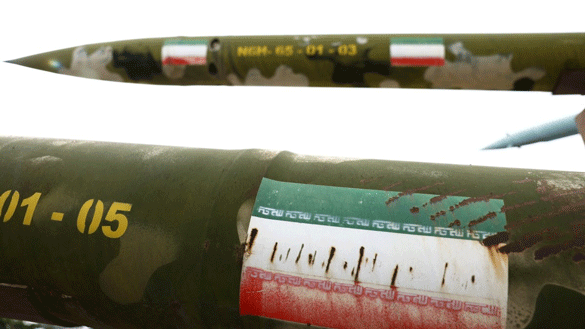
There is no clear winner in this war, and the timeline for how and when it will end remains uncertain. At present, neither side is in a position to declare victory, and the conflict may never produce an outcome where any party can claim an unqualified triumph.
From the American perspective, striking tens of thousands of targets in Iran, eliminating senior officials and destroying infrastructure may constitute technical achievements. But results that can be presented as successes do not amount to victory when they fall short of the stated strategic objective. Even if framed as a victory, they will not be received as such by the relevant audiences.
The threshold for what constitutes winning differs sharply between the belligerents. For a great power like the United States, that threshold is very high. If it does not win decisively, it is seen as having lost. For a smaller power, victory can be defined far more modestly: not being defeated by a great power, or simply enduring, is itself a form of winning. In this context, Iran's victory threshold is survival.
There is also a considerable gap between the strategic objectives the U.S. held at the outset of the war and those it holds four weeks in. The initial goals were ambitious: regime change first, then the elimination of Iran's nuclear and missile capabilities, followed by the establishment of a postwar Iranian government aligned with Washington. Now, securing or controlling the Strait of Hormuz may be what gets presented as a "victory." The larger the original objective, the broader the definition of failure becomes.
What has also become clear is that Iran is not simply a narrow regime. It is a deep and extensive state ecosystem. The Iranian system is not held together by ideology or religion alone. It consists of more than a million bureaucrats who identify with the state, who understand that their own survival is bound to its survival, and who would have no viable existence if the state ceased to exist.
The continuation of this structure will itself be seen as a victory by the regime's forces. If a cease-fire were reached today, Iran could readily claim it had won the war.
Even if Iran suffers severe losses across every dimension, the survival of the regime and the structural and institutional continuity of the state could accelerate the postwar recovery process. The regime may, in fact, emerge more confident, both in intensifying domestic repression and in projecting regional pressure and hegemony.
In the postwar period, the Iranian regime may abandon its longstanding nuclear threshold policy, the posture of possessing the capacity to build a nuclear weapon without actually doing so, and redefine weaponization as a legitimate and necessary security guarantee, justified by the price already paid. Until now, Tehran had maintained the strategy of remaining a threshold state precisely because crossing that line was understood to risk triggering direct military intervention and far harsher sanctions. But Iran has now been subjected to a comprehensive military assault without having built the weapon. This will likely spread the conviction within Iran that remaining without nuclear deterrence was a strategic error. That shift in thinking could reframe the nuclear weapon not as a risk to be managed but as an indispensable security guarantee.
Iran will also construct a victory narrative from having globalized the cost of the war and transferred a disproportionate share of it onto the Gulf. The economic and security model that Gulf states have built over decades has sustained serious damage. Going forward, Gulf countries will begin questioning the "security purchasing" model they have sustained for decades. Despite enormous military expenditures, the inadequacy of external protection mechanisms in a moment of genuine crisis has been made plainly visible. Over the long term, Gulf states may look toward new strategic orientations and multi-directional alliances.
Ultimately, this war will be shaped less by what the parties achieved on the battlefield than by what they failed to achieve. The U.S. can demonstrate military superiority, but as long as it cannot translate that superiority into a strategic outcome, the claim to victory will remain weak. Iran, despite paying a severe price, will define itself as the winner to the extent that it remained standing, kept its system functioning, and frustrated the objectives of the other side.
https://www.dailysabah.com/opinion/columns/why-neither-us-nor-iran-can-claim-victory-and-what-comes-next
----
Made in Türkiye: Lessons from the Roketsan Strategic Summit
BY DENIZ İSTIKBAL
APR 03, 2026
Modern warfare accelerated with the steam engine and came of age through industrial firepower. By the post-World War II era, air and space technologies had redefined military power, pushing nations like Türkiye into alliances such as NATO in 1952. Yet dependence came at a cost. When sanctions followed the 1974 Cyprus Peace Operation, Türkiye was forced to confront a hard truth: true security required a domestic defense industry. Efforts to nationalize land, naval and air systems began to bear fruit in the early 2000s.
In the first quarter of the 21st century, the sector grew rapidly compared to its global competitors and entered the top 10 with an export capacity of $10 billion. With platforms such as the Altay tank, the Atak helicopter, the TCG Anadolu warship, unmanned aerial vehicles (UAVs), unmanned combat aerial vehicles (UCAVs), Kızılelma and others, the Turkish Defense Industry has transformed into a new-generation production model. Major contributions to this growth have come from companies such as Aselsan, Havelsan, STM, MKE and Baykar Technology.
Among the key providers of the modern technological capacity achieved by the Turkish defense industry, Roketsan holds a particularly important position.
The company ranks as the 71st largest defense firm in the world, rising nine places compared to the previous year. Roketsan focuses on high-technology and research and development-driven missile and air defense systems. Established in 1988, the company was designed as a joint venture of other defense industry firms. Since its founding, it has produced modern weapons in line with the needs of the Turkish Armed Forces (TSK).
Strategic Partnership Summit
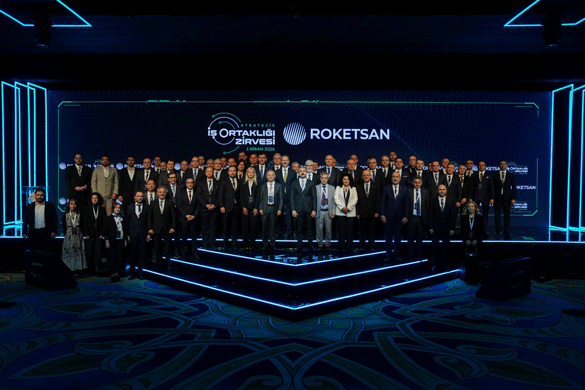
The Roketsan Strategic Partnership Summit held on April 1 has significant importance within the company’s corporate vision. It was organized with the participation of more than 100 partner companies collaborating with Roketsan. Key topics discussed included joint production processes, digitalization, sustainability, risk management, innovation, supply chains and national capabilities.
Representatives from many countries also attended the summit. During the event, it was emphasized that Roketsan has surpassed the $1 billion threshold, while its annual product delivery capacity growth was also a major point of discussion. Particularly in the 2020-2025 period, Roketsan’s growth rate has significantly diverged from both the national economy and other companies. Utilizing 92% domestic resources, the company aims to expand its activities across a wide range of areas, from supply chains to next-generation technologies.
Among the key points highlighted at the summit were long-range systems, which are considered a necessity of modern warfare and represent an outcome of the company’s strategic focus. The transformation of existing capacity toward a space-centered structure and the development of infrastructure for long-range systems will be carried out in cooperation with more than 100 private sector partners. Initiatives to be implemented with a national vision can be regarded as one of the most significant outcomes of the summit.
Place in industry
The missile systems developed by Roketsan have been exported to various countries, and weapons tested in the field have both enhanced the striking power of the TSK and increased its deterrence capability. Operating across a wide range of areas, including space projects, air defense systems, land systems, naval systems, precision-guided systems, ballistic protection systems and subsystems, Roketsan stands at the center of global competition.
In the field of air defense systems, Roketsan designs and produces missiles and firing equipment. The company produces artillery rockets, multiple launch rocket systems and rockets for various platforms. The new-generation heavy-class torpedo and the anti-ship missile Atmaca are being delivered to the TAF by Roketsan.
The company, which is also responsible for the development and mass production of precision-guided missiles, focuses on medium and long-range ballistic missiles as well. The changing nature of conflicts and rapid advancements in missile technologies have highlighted Türkiye’s need for such capabilities. Therefore, deliveries of the Tayfun ballistic missile and the Som cruise missile are continuing at a rapid pace. Tayfun’s high cruising speed, which reduces its vulnerability to air defense systems, represents advanced technology by contemporary standards.
As Türkiye’s longest-range ballistic missile, Tayfun is capable of striking strategic targets such as air defense systems, armored and unarmored military assets, command and control centers, critical infrastructure, and even aircraft hangars.
The Som missile, on the other hand, provides a highly destructive capability against mobile land and naval targets in high-intensity conflict environments. With a range of 250 kilometers (155 miles) and the ability to carry various types of warheads, Som can also be deployed on unmanned aerial platforms. Its effectiveness against surface targets, bunkers, and air defense batteries highlights the advanced technological capabilities developed by Roketsan.
Shaping the future
It can be said that Roketsan is shaping the future, as it is expected to place greater emphasis on areas such as the use of space, shortening production and delivery times, extending the range of rocket and missile technologies, as well as communication, reconnaissance-surveillance, positioning and process management.
As part of the National Space Program, the firm focuses on achieving independent access to space through national capabilities. The company is expected to launch micro-satellites into space starting from the final months of 2026, and it is also anticipated to contribute to civilian aviation technologies.
With 2030 set as a strategic target, the company aims to become a global actor, especially in air defense systems. Having already exported to more than 50 countries, the company seeks to expand its export destinations from Latin America to Asia through increased capacity. It has also implemented joint production models with countries such as Hong Kong, Saudi Arabia, Indonesia and Azerbaijan, highlighting its emergence as a new-generation enterprise. With a projected revenue of $2 billion and a business volume of $10 billion, Roketsan is positioning itself among the largest companies in its region and representing an important outcome of the “Made in Türkiye” brand.
In conclusion, Roketsan has become a decisive, closely watched and innovative player in the Turkish defense industry on the global stage. The atmosphere at the April 1 summit reflects the company’s current capacity and the strong image it has built. At a time when new goals must be assessed in light of past achievements, Roketsan’s progress stands out as a model for other companies.
https://www.dailysabah.com/opinion/op-ed/made-in-turkiye-lessons-from-the-roketsan-strategic-summit
------
Truce with Iran is not weakness but a strategic necessity
AFZAL KHAN
April 03, 2026
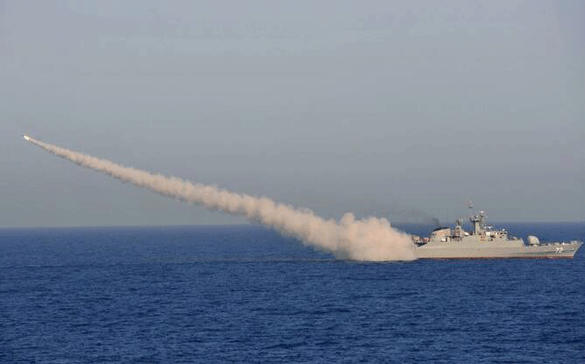
The past month has tested the Middle East to breaking point. Following US-Israeli strikes on Iranian targets at the end of February, Tehran attacked Gulf infrastructure and disrupted shipping in the Strait of Hormuz. Oil prices have surged, global supply chains are strained, and households are feeling the squeeze at the petrol pump and on their energy bills.
In such circumstances, the case for urgent de-escalation is overwhelming. Yet de-escalation must never mean disengagement.
Britain’s interests, our allies’ security and the stability of the global economy demand a calibrated response that defends partners without being drawn into open war.
UK Prime Minister Keir Starmer’s decision not to commit British forces to direct offensive operations against Iran was not hesitation, but statecraft. The Labour government has acted with speed and purpose, deploying an additional Typhoon aircraft, helicopters and an air defense battery to protect Gulf partners in Bahrain, Kuwait, and Saudi Arabia. Royal Navy assets have been positioned to try to keep the strait open. UK Foreign Secretary Yvette Cooper has visited the region, the Cobra emergency committee has met repeatedly to manage the domestic cost-of-living fallout, and the Ministry of Defense has convened urgent roundtables to accelerate the supply of counter-drone systems and integrated air defenses.
These steps are modest in scale, but decisive in effect: They are protecting British bases, working to safeguard the 20 percent of world oil that passes through the Strait of Hormuz each day, and demonstrating to our partners in Europe and the region that Britain remains a reliable friend amid global instability.
Such actions are not partisan improvization. They are the latest chapter in a long historic relationship. British and Gulf forces have trained and operated together for decades, from the liberation of Kuwait in 1991 to the campaign against Daesh. Joint counter-terrorism and intelligence work has thwarted plots in London, Riyadh, Dubai, and Manama.
The Iranian threat may now wear new tactical clothing — swarms of inexpensive drones, proxy militias, and hybrid attacks on shipping — but its strategic character is grimly familiar to every Gulf and British planner who has studied the region for the past 40 years.
That is why Britain’s interests are best served by deeper, not narrower, regional relationships. Stronger ties with Egypt, Turkiye, and Pakistan offer essential strategic depth. Egypt anchors the Arab world’s most populous state; Turkiye is a NATO ally with real convening power; Pakistan is a nuclear power whose stability matters to the entire Islamic world.
Any future diplomatic architecture that ignores these players will be as fragile as the 2015 Iran nuclear deal proved to be. That agreement was a technical success in limiting enrichment, but a strategic failure because it excluded the very states most exposed to Iran’s ballistic missiles, regional proxies, and destabilizing behavior. Gulf partners were not at the table; their legitimate security concerns were treated as an afterthought. The next agreement — if there is to be one — must be inclusive from the outset.
The Gulf states have already shown they will not wait passively for others to guarantee their security. They remain loyal to their traditional Western partners, yet recent events have left an understandable sense of disappointment in some Gulf capitals: a perception that US policy has, at critical moments, elevated Israel’s immediate interests above the collective security and economic stability of the Gulf itself.
This is precisely the moment for Britain to step forward as the dependable partner we have always been. The old rentier model, in which security was largely imported and oil rents funded everything else, is being quietly dismantled. Saudi Arabia is on track to meet half its defense needs from domestic production by 2030 and is already a serious manufacturer of land systems, autonomous platforms, and munitions. The UAE’s Edge Group, Qatar’s Barzan Holdings, Kuwait’s growing defense investments, and Bahrain’s integration into the Comprehensive Security Integration and Prosperity Agreement framework are all part of the same story: sovereign capability married to smart partnership.
These states have exercised remarkable restraint in the face of direct Iranian aggression. They are trying to keep the strait open and are focused on the long-term prize — diversified, knowledge-based economies that can deliver prosperity for their young populations.
Britain can and should do more to support them, through expanding joint training programs in Oman, deepening technology transfer and co-development agreements to help Gulf industries grow while creating high-skilled jobs at home, and we should offer to join responsible, multinational coalitions to secure the strait. We should use every diplomatic lever to bring Egypt, Turkiye, and Pakistan into a broader regional security conversation. History shows what is possible when Britain plays this role intelligently: The post-1991 security architecture that helped stabilize the Gulf for a generation was built on exactly such an inclusive partnership.
Britain and Iran have had political relations since the 13th century. The current geopolitical landscape of Iran, Russia, and China against the West is a modern configuration — but is by no means permanent. Instead of pushing Iran further to the East, Britain can rebuild political ties and bring Iran back into the fold.
De-escalation has become imperative, but will only endure if it rests on credible deterrence and genuine regional ownership. By standing shoulder to shoulder with Gulf allies at a time when trust in other partnerships has been strained, by recognizing how profoundly their defense and economic strategies have evolved, and by insisting that any new diplomatic settlement includes every major player with a stake in Gulf security, Britain can help turn the present crisis into the foundation of a more stable order.
That is the Labour way: principled, pragmatic, and rooted in alliances that have served both our security and our prosperity for two centuries. In the weeks and months ahead, we must prove it once again.
https://www.arabnews.com/node/2638677
------
Public opinion in Turkiye is clear: Stay out of this war
DR. SINEM CENGIZ
April 03, 2026
For more than two decades, Turkiye has lived with wars on its doorstep — first Iraq, then Syria, and now Iran. None of these conflicts have remained within the countries’ borders, and all have affected Turkiye’s security, economy, and domestic politics.
Over time, Turkiye has adopted an increasingly proactive foreign policy in response to geopolitical transformations and the structural challenges posed by its neighborhood. With the country playing a greater role in regional issues, its population has also taken a growing interest in Ankara’s foreign policy decisions.
Most Turkish people oppose the country being dragged into any war. If anything, they prefer Turkiye to act as a mediator. According to a recent public survey that asked what Turkiye’s policy should be in the conflict between Iran and the US, most preferred neutrality or supported brokering peace. There is strong public opposition to US and Israeli military action, but that does not mean there is support for the Iranian regime.
Turkiye’s position is delicate here because it is the only NATO member that shares a long land border with Iran. That alone makes things more difficult for Ankara. On the one hand, it is part of the Western alliance, while on the other, it risks facing the consequences of whatever happens next door. Historically, Turkiye’s membership in NATO has shaped its policies not only with the West but also with its neighbors — a situation that calls for clear neutrality.
However, this neutrality is far from passive, because Turkiye cannot afford that. Rather, we currently see an active neutrality, where Turkiye is trying to be part of a peace framework — as seen in its cooperation with Pakistan, Egypt, and Saudi Arabia — while also avoiding being drawn into the conflict by refusing to allow its territory and airspace to be used by the US in military operations against Iran.
Politically, Turkiye has not aligned with any of the parties in the Iran conflict. This is not the first time in Turkish political history that the country has taken such a stance. When the US launched its war against Iraq in 2003, most Turkish people opposed the conflict. This was one of the strongest anti-war public opinions in any NATO country at the time and was particularly striking given the alliance between Ankara and Washington. As a result, the Turkish parliament voted against allowing US troops to open a northern front from Turkish territory. Despite pressure from the US, Turkiye refused to become part of that war, with public opinion playing a crucial role in the decision. Turkiye has existed within the Western system while its public remains skeptical of the West.
In fact, the end of the Iraq war did not change Turkish public opposition to US policy in the region. If we look at public opinion now, the pattern is similar.
Turkish people oppose the war even if it results in the fall of the Iranian regime; they are skeptical of US intervention, and worried about what comes next. This shows a consistent public mindset in Turkiye that is shaped by four main dynamics: fear of regional spillover, distrust of US policies, popular anti-war sentiment, and economic and refugee-related concerns.
The Turkish public and political parties fear that further escalation of the war could make Turkiye a primary destination for refugees. During the 2010s, millions of Syrians fled to Turkiye, resulting in economic, social, and security pressure on the country. A similar pattern happened during the Iraq conflict. Now with a similar situation in Iran, a country with a much larger population, the scale is likely to be greater. In addition, there are concerns over disruption to the fragile Kurdish peace process at home.
Traditionally, on foreign policy issues, the Turkish political spectrum is complex. There are several sentiments, including anti-Western or anti-imperialist discourse; Islamic, especially regarding issues such as Palestine; and pro-Western perspectives.
In the Iran war, although the desire for neutrality is shared, all parties have differed in their tone as a reflection of their ideological backgrounds. Turkiye’s ruling AKP has emphasized the importance of diplomacy and opposed violations of any country’s sovereignty. Its nationalist ally MHP is also against the war, but has raised concerns about suggestions that Turkiye could be the next target after Iran, especially in the wake of statements by some Israeli officials. The main opposition party, CHP, also condemns US and Israeli attacks on Iran, but is critical of the Iranian regime’s domestic policies. Lastly, the pro-Kurdish DEM party opposes the war, while also viewing the possibility of regime change in Iran more positively.
As was the case with previous conflicts in neighboring countries, the Iran war also tops Turkiye’s political agenda. Despite slight differences in the tones of the political parties, the overall pattern is clear: Turkiye should stay out of this war.
Turkish foreign policy has a long history of diplomacy under tense conditions. Ankara’s current neutrality is not only the government’s preferred position but also reflects the broader political spectrum and an increasingly influential public opinion. Given Turkiye’s NATO membership and its active role in regional politics, its neutrality should be understood within a broader perspective. This stance is not passive, but is both a necessity driven by structural constraints and a product of domestic political and economic factors.
https://www.arabnews.com/node/2638666
-------
How Did Iran Shoot Down a US Fighter Jet? Inside Iran’s Air Defense Network
April 3, 2026
A month into the war, available reporting across Western, Iranian, and independent defense sources points to a consistent military picture: Iran’s air-defense network has been degraded, but it remains operational.
Confirmed incidents include the loss of a US fighter jet over Iran on April 3, as reported by Reuters and The Washington Post, alongside earlier damage to an F-35 and repeated losses of MQ-9 drones during operations over Iranian territory.
These developments indicate that US aircraft continue to operate in contested conditions rather than a fully permissive environment.
At the same time, data compiled by conflict monitoring organizations such as ACLED shows that hundreds of Iranian air-defense assets were targeted in the early phase of the war. However, subsequent battlefield activity suggests that enough capability survived to maintain a functioning defensive system.
What is The Structure Of Iran’s Air Defense System?
Iran’s air defense is structured as a layered system composed of long-, medium-, and short-range components operating in coordination.
At the upper tier is the Bavar-373, a domestically developed long-range surface-to-air missile system designed to engage aircraft, drones, and cruise missiles.
Defense reporting indicates the system uses phased-array radar and Sayyad-series interceptors, with an operational range exceeding 200 kilometers, according to technical overviews published by regional defense outlets such as VietBao.
The middle layer includes systems such as Khordad-15, which can track multiple targets simultaneously and engage aircraft at intermediate ranges. Analysis published by Global Defense Corp describes it as capable of engaging low-observable targets at shorter distances, complementing longer-range systems.
At lower altitudes, Iran employs short-range systems and point-defense platforms, including Tor-type interceptors and other mobile units, creating overlapping coverage zones.
This layered configuration allows different tiers to remain functional even when others are degraded.
How is The System Integrated?
Iran’s air-defense system operates as a network rather than as isolated units.
Satellite imagery analysis and defense reporting before the war indicated that Iran integrated Russian-origin systems such as the S-300 alongside domestically produced platforms.
According to Defense Security Asia, this created a hybrid architecture combining multiple generations of technology within a single operational framework.
This integration allows for variation in radar frequencies, tracking methods, and engagement profiles. It also reduces reliance on a single system or command structure, complicating suppression efforts.
How are Targets Detected?
Detection methods appear to extend beyond traditional radar.
Modern stealth aircraft are designed to reduce radar visibility but remain detectable through other signatures.
Defense reporting and technical analysis indicate that Iran employs a combination of radar, infrared, and electro-optical systems to identify airborne targets.
Technical overviews of Iran’s radar network describe the use of passive detection systems capable of identifying heat signatures and emissions. These systems operate with lower electromagnetic output, making them less vulnerable to jamming and electronic warfare.
This multi-method approach does not eliminate detection challenges but increases the probability of intermittent tracking sufficient for engagement.
How has the System Survived Initial Strikes?
Early in the campaign, US and Israeli officials stated that a significant portion of Iran’s air defenses had been neutralized, or totally ‘oblierated’. Conflict data compiled by ACLED indicated that more than 200 systems were targeted during the opening phase.
However, continued battlefield activity suggests that the system retained functionality.
The survival of Iran’s air defenses appears linked to dispersion and system design.
Rather than relying on centralized infrastructure, Iran’s network includes mobile launchers and distributed radar units. This reduces vulnerability to follow-up strikes targeting command-and-control nodes.
Defense analysis published by Army Technology has noted that while the network suffered degradation, it did not collapse entirely, indicating structural resilience.
What Role Does Mobility Play?
Mobility is a key operational factor.
Iranian air-defense systems are typically mounted on mobile platforms, allowing relocation after detection or engagement. This reduces the effectiveness of suppression strategies that depend on tracking and destroying fixed positions.
Recent reporting on upgrades to systems such as Bavar-373-II, cited by Army Recognition, indicates increased autonomy, with launchers capable of operating independently. This further reduces dependence on centralized coordination and increases survivability.
Mobility also contributes to uncertainty in targeting, as system locations may change frequently.
How Does Redundancy Affect Performance?
Iran’s system incorporates redundancy across multiple layers.
Older systems, including legacy Soviet-era platforms, remain in operation alongside newer domestic systems. While these older platforms are less advanced, they contribute to overall system density.
Regional defense assessments published by outlets such as Forum for Maritime Security note that this redundancy increases the number of potential targets and complicates suppression efforts.
The result is a higher volume of defensive activity, even if individual systems have limited capability.
What External Technologies are Involved?
Iran’s air-defense architecture includes both domestic and foreign components.
In addition to indigenous systems, reporting indicates the integration of Russian-origin platforms and, in some cases, Chinese-designed technologies. Industry analysis published by Spherical Insights notes that such hybridization introduces diversity in system behavior and technical characteristics.
This diversity affects radar coverage, missile guidance, and system interoperability, making the network less predictable.
How Could This have Led to the Downing of A US Fighter Jet?
Available data allows for a plausible operational sequence based on known system capabilities.
Detection could have occurred through a combination of radar and passive systems.
As outlined in technical reporting on Iranian air defenses, including coverage by VietBao, passive sensors such as infrared and electro-optical systems can identify aircraft through heat signatures or emissions, even when radar visibility is reduced.
Once a target is detected, tracking may be maintained through integrated radar networks or short-range systems operating within overlapping coverage zones.
Medium-range systems such as Khordad-15, described in analysis by Global Defense Corp, are designed to engage multiple aerial targets and may operate in conjunction with other sensors.
Engagement would likely involve surface-to-air missiles launched from mobile platforms. The use of dispersed launchers reduces vulnerability to counterstrikes and allows for engagement from multiple positions, increasing the probability of a successful hit.
Additional factors may include electronic warfare conditions, the presence of multiple threats in the airspace, and the cumulative effect of sustained operations over time. Reporting by Air & Space Forces Magazine and other defense outlets has noted that even advanced aircraft can be exposed to risk when operating repeatedly in contested environments.
Taken together, these elements—multi-layer detection, integrated tracking, mobile launch systems, and overlapping engagement zones—provide a framework through which the downing or damage of advanced aircraft can occur under current battlefield conditions.
https://www.palestinechronicle.com/how-did-iran-shoot-down-a-us-fighter-jet-inside-irans-air-defense-network/
------
The Collapse of ‘Independent’ Arab Media — The Curious Case of the Downed US Jet
April 3, 2026
The irony is striking.
At the very moment when US officials are acknowledging that a fighter jet has been shot down over Iran—thus validating earlier Iranian claims—an Arab military analyst, speaking on a major Gulf-based network, was busy casting doubt on the same story.
His argument rested on what he described as insufficient visual proof. The images circulated by Iranian media, he noted, focused largely on fragments—particularly a tail section—arguing that such material, on its own, does not conclusively demonstrate that an advanced aircraft like the F-35 was fully destroyed.
Technically, this may sound like a cautious, professional assessment. But politically, it reflects something far more consequential.
Because the same level of scrutiny is rarely applied to narratives flowing in the opposite direction.
Throughout this war, Arab media coverage—across much of its ecosystem—has consistently emphasized destruction inside Iran, the interception of Iranian missiles, and the supposed effectiveness of US and Israeli operations. Meanwhile, the missiles that do reach their targets, the infrastructure that is successfully hit, and now, critically, the downing of US aircraft, are treated with hesitation, doubt, or marginal attention.
This is not an isolated editorial choice. It is a pattern, and it is increasingly difficult to separate this pattern from the broader political positioning of Arab states themselves.
Indeed, there is a certain logic to this alignment.
Iran’s retaliatory strikes have not been confined to Israel. They have targeted US military bases and economic assets across the region, including in Arab countries. Under such conditions, the space for genuine neutrality narrows considerably. Media narratives begin to reflect not only journalistic judgment, but also national anxieties and strategic calculations.
Objectivity, in this context, becomes conditional. Yet even within these constraints, the refusal to fully engage with the implications of what has just happened remains striking.
Because what has just happened is not ambiguous: A US fighter jet has been shot down over Iran. US officials have confirmed the loss and acknowledged ongoing search-and-rescue operations for the crew. Multiple international outlets have reported the incident, marking the first such loss since the war began.
Whether the aircraft was an F-35, as Iran insists, or another advanced platform such as an F-15, as some Western reports suggest, does not fundamentally alter the strategic significance.
A US warplane has been downed in contested airspace. This matters, and matters greatly.
In fact, that alone is enough to dismantle weeks of confident assertions that Iran’s air defenses had been neutralized, that its skies were effectively open, and that US forces were operating with near-total impunity. Those oft-repeated claims can no longer be sustained.
But instead of confronting this contradiction directly, much of the discussion—particularly in Arab media—has been redirected toward technical doubt, fragment analysis, and speculative alternatives.
The more important questions are being avoided: If Iran is capable of shooting down advanced US aircraft—indeed, if it has done so twice within hours, as Iranian sources report—then what does this say about the actual balance of power in the skies?
What systems are being used?
Are these domestically developed capabilities, refined under years of sanctions and isolation? Are they the result of Chinese infrared detection technologies, as even skeptical analysts have hinted? Or do they represent a hybrid system, combining multiple technological inputs into a new, adaptive air defense network?
These are the questions that should dominate serious military analysis. Instead, the focus remains on whether a piece of wreckage is “sufficiently convincing.”
This is not an analysis. It is obviously a deflection, because to seriously engage with the implications of these developments would require revisiting one of the central claims of the war—that the United States had achieved early and overwhelming control over Iranian airspace.
It would mean acknowledging that this claim was, at best, premature. And at worst, fundamentally incorrect.
The downing of a US fighter jet—particularly one operating in what was assumed to be a permissive environment—suggests that Iran retains not only defensive capacity, but also the ability to impose costs on even the most advanced air forces in the world.
This is a strategic turning point.
It suggests that the war is not unfolding as a one-sided campaign of dominance, but as a contested confrontation in which assumptions are being tested—and, increasingly, overturned. And it raises broader questions about the direction of the conflict itself.
If US air superiority can be challenged, then escalation becomes far more unpredictable. The expectation of quick, decisive outcomes begins to erode – in fact, it already did. The risk of prolonged confrontation, with mounting costs and uncertain endgames, becomes far more real – in fact, it is.
Yet here, another contradiction emerges. While US media has been openly critical of the war—highlighting the lack of strategic vision, the absence of a coherent “day after” plan, and the haphazard nature of decision-making—much of Arab media has taken a different path.
Not necessarily pro-war. But certainly not opposed to it.
Reports have begun to indicate that several Gulf states, whether openly or discreetly, are supportive of an expanded US role in the conflict—effectively aligning with the broader strategic objectives of Israeli Prime Minister Benjamin Netanyahu, a wanted criminal, in the region.
Within this context, Arab media appear to be navigating a narrow and carefully managed space: maintaining an appearance of credibility and independence, while avoiding direct confrontation with prevailing state positions.
The result is a form of selective framing. The war is covered, but not fully interrogated. The consequences of the war are reported, but its underlying assumptions are left largely intact.
And developments that disrupt the dominant narrative—such as the downing of US fighter jets—are absorbed into a discourse of doubt rather than analysis.
This is not new. Arab media has rarely been truly independent, even when it has successfully projected that image.
For years, certain outlets positioned themselves between two worlds: the rigidity of state-controlled media and the biases of Western coverage. This positioning earned them credibility—particularly among audiences in the West searching for alternative perspectives.
But credibility, once established, can also function as a shield. A way of shaping narratives more subtly. More effectively.
Today, that subtlety is on full display. Not in the facts themselves, but in how they are framed.
As the downing of a US fighter jet becomes harder to dispute, much of Arab media has not denied the event—but has contained its meaning. What should register as a strategic rupture is reduced to technical debate and cautious language.
But this is not about a single incident.
Across the war, the pattern is consistent: facts are acknowledged, but their implications are restrained. Developments are reported, but rarely allowed to disrupt the broader narrative.
This is the real issue. Because independence is not measured by what is reported, but by what is allowed to matter.
Here, that boundary is clear.
Arab media is not simply describing the war—it is defining the limits of how the war can be understood, for reasons that speak for themselves.
https://www.palestinechronicle.com/the-collapse-of-independent-arab-media-the-curious-case-of-the-downed-us-jet/
------
‘The Missiles Won’t Only Come from Iran’: Syria Rises Up in Support of Palestine
April 3, 2026
By Robert Inlakesh
As Syrian armed groups in the nation’s south declare war on the Israeli occupiers of their land, following the eruption of demonstrations in support of Palestinian prisoners. If there is one issue that could unite Syria, it is Palestine. If there was ever a time for a Syrian war front against the Zionist occupation, it is now.
On March 31, demonstrations erupted in the countryside of Syria’s southern cities of Dara’a and Quneitra, declaring their outrage at Israel’s decision to execute Palestinian political prisoners. That same night, an armed group based in the Dara’a area declared that they would begin waging an armed struggle against Israel. The intensity of the protests, some of which were within the sights of Israeli occupying forces, began to spread and reached the city of Hama.
The following day, the protests then exploded across the country. A large gathering took place in the University of Aleppo, as demonstrations went on throughout the day. Homs, Damascus, and Latakkia ignited into protest, with chants in support of Gaza, while the marches in Dara’a and Quenitra expanded. More groups in the Dara’a countryside, starting in the town of Zakiyah, began openly declaring war on the Israelis.
One protester in Dara’a told a local TV channel that if the law adopted by the Israeli Knesset is not retracted, “missiles will not only come from Iran, the Syrian border will ignite and the missiles will come from here”.
Abu Obeida, the Spokesperson of Hamas’ armed wing, the Qassam Brigades, released a statement on the demonstrations, stating:
“From the heart of proud Gaza, and from Al-Quds and its surroundings, we send greetings to the noble people of Syria and their masses who came out chanting for the resistance and in support of Al-Aqsa and the prisoners. We say to them: Your voice has reached us, and we are proud of you. Our hopes, after Allah, are tied to you and to all free people. We trust that the masses of our nation will one day unite and forge their path to liberate the sanctuary and the prisoners.”
It suffices to say that the Syrian streets ignited over this issue. Which begs the question as to what option against Israel could prove possible and how this situation may escalate.
The first major issue is that of the Hayat Tahrir al-Sham (HTS) government in Damascus, which has clearly aligned itself with the United States and the West. Earlier this year, it agreed to a “joint fusion mechanism” which was aimed at facilitating economic and security ties, a soft agreement aimed at forwarding normalisation efforts.
However, the Syrian government does not have full control over its country and its new security apparatus are not even all necessarily ideologically committed to the State. It should be noted that instead they are of a range of military factions, many of whom were formerly aligned with Al-Qaeda, and could break ranks in the event that a major confrontation with Israel unfolds.
Syria is by no means a simple country to understand and is far from a united country under a strong central government. Despite most of its territory being under the de facto control of Damascus, local armed groups, tribal militias and ideological militias hold tremendous power in different corners of the country.
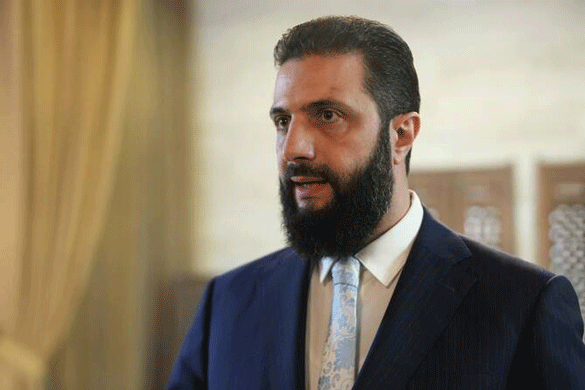
If a confrontation with Israel is going to happen, it will not be ordered by Ahmed al-Shara’a, on the contrary he is likely working to block this from happening at all. The Syrian leader is solidly in the camp of the United States, which means that places him in the Israeli sphere of influence.
His position is far from secured in the long term however. The Israelis have been hesitant about going too far with their normalisation efforts for this reason, amongst others. If Al-Shara’a manages to bring Syria under his full control and rule it in the way Bashar and Hafez al-Assad did, then the Israelis would likely proceed with normalisation at some point.
But at this time, the Israelis are still taking advantage of the Syrian State’s weakness, which they partially designed with their large-scale destruction of Syria’s strategic weapons. When Hayat Tahrir al-Sham entered Damascus, they also decided to disband the former Syrian Arab Army and security apparatus. The only elements of the former State that they decided to keep in place, were those who would aid in running corrupt schemes inside the country.
For the Israelis, they saw this as a golden opportunity to seize more Syrian lands and even back Druze separatist factions. The idea here was for Ahmed Al-Shara’a to respect their boundaries, allow them to achieve their goals and aid them directly, while also backing the Druze to fulfill their goals simultaneously.
Al-Shara’a is also the only man who was available to prevent a return to a civil war-style power struggle from breaking out, which carries the risk that an anti-Israeli government could take over. This possibility was also why the Israelis destroyed much of Syria’s military capabilities.
At the start of the regional war with Iran and its allies, the Israelis also notably began bombing Syrian military sites. The reason for this is simple: they were spooked by the possibility that the Syrian State could make a move on Sweida, to take out the Druze separatist factions. A development which would not only threaten the “Greater Israel Project”, but could also drag the Israeli military into another confrontation.
Therefore, the bombing was a warning to the HTS leadership, a message that they have to play ball and shouldn’t get any ideas, or that Al-Shara’a shouldn’t start to grow confidence and begin resembling Iraq’s Saddam Hussein. While the region was on fire, the Syrian leader then went on a Europe tour, displaying a complete disconnect from the event unfolding on the ground.
Which is where we come back to southern Syria. The south has been left for dead by Damascus; if anything, the HTS leadership has behaved similarly to how the Lebanese government of Nawaf Salam has in southern Lebanon.
Routine bombings, Israeli checkpoints, the abduction of civilians, raids into villages, all as the Israelis pressured Damascus to disarm the south of Syria. Yet, the people of Dara’a and Quneitra refused disarmament.
The military capabilities of the large series of armed groups in Syria’s south are relatively unknown, but it is safe to say that they don’t even begin to match up to those of Lebanese Hezbollah. These groups consist of a mixture of former anti-Assad militia members, combined with former Syrian Army officers, commanders and simply local fighters.
Under normal circumstances, it would be tough for these armed groups to stand up to the Israeli military. However, the regional war now presents a historic opportunity that will not likely present itself again. A Syrian front against the Israelis would prove a major challenge right now.
Tel Aviv is already struggling to muster the amount of troops necessary to invade and occupy southern Lebanon, as they take a beating from Hezbollah. The Israeli air force is also distracted by its bombing campaigns on multiple fronts. If they have to either fight off frequent ambushes near the Golan Heights or even commit to a broader invasion of Syria, it will be massively taxing on their military.
In the event of a major escalation in southern Syria, fighters affiliated with the new Syrian armed forces and security apparatus may also break ranks to fight Israel. Bedouin Tribal militias could potentially join this fight too, as will a series of Syrian resistance factions aligned with the Iranian-led Axis of Resistance.
If things spiral out of control inside Syria, the Israelis may pursue the assassination of al-Shara’a, who they will no longer see as much of a need for, but this, too, may backfire. As of now, sectarian violence, a dire economic situation, and public dissatisfaction with the way the country is heading all present major challenges to future stability inside the country. Yet, a front forming against the Israelis could hold the key to uniting a large portion of the population. It won’t fix all of Syria’s problems, but the people will see a common enemy, and that much can be agreed upon.
It may be too early to call exactly where the momentum on the streets is going to lead, but there is certainly potential there for a major development that could alter the course of this regional war.
https://www.palestinechronicle.com/the-missiles-wont-only-come-from-iran-syria-rises-up-in-support-of-palestine/
-------
A Question of Violence: Palestine in American Academia After October 7
April 3, 2026
By Omar Zahzah

Another name has joined the ever-growing roster of academics facing repression over Palestine: Idris Robinson. On March 24, 2026, Robinson filed suit against his employer, Texas State University, which is seeking to fire Robinson from his position as Assistant Professor of Philosophy on May 31, 2026, for a talk he gave about Palestine during an off-campus event in the Summer of 2024.
The suit names Texas State University President Kelly Damphouse, Provost Pranesh Aswath, Senior Vice-Provost Vedaraman Sriraman, Thillainatarajan Sivakumaran, inaugural Vice President of TXST Global, and the Regents of Texas State University. Damphouse also initiated the illegal firing of TSU History Professor Tom Alter in November 2025 for an off-campus talk Alter gave at a Revolutionary Socialism conference.
On June 29th, 2024, Robinson delivered a talk entitled “Strategic Lessons from the Palestinian Resistance” in Asheville, North Carolina, as part of an anarchist book fair. A fight broke out during Robinson’s presentation when it was discovered that Zionists were in attendance and filming the proceedings; Robinson was escorted out of the room and gave follow-up commentary in a Q & A session the next day.
As reported in the Guardian, on June 5, 2025, David Moritz, one of the Zionists who had surreptitiously filmed Robinson’s talk, made an Instagram post targeting Robinson and blaming him for the fight that broke out in June 2024: “This professor praises violence and incited a mob attack in Asheville,” Moritz wrote in the first slide.
The next day, despite a stellar teaching record, Robinson received an email from senior vice-provost Sriraman informing him that he was being placed on academic leave “following the receipt and internal assessment of multiple complaints and allegations regarding an incident that occurred in the summer of 2024,” and on July 8, 2025, administration notified him that his contract would be terminated in May 2026. Robinson appealed the decision, and Texas State University denied his appeal, despite being unable to substantiate its decision nor clarify exactly what rules or laws Robinson had allegedly violated, per the Guardian.
For his part, Moritz made his goal manifestly clear. He concluded his Instagram post with the following sentiments and call to action:
This isn’t academic freedom
This is incitement to violence
This is glorification of terrorism
And it happened under the name of a US university
Texas State University must act
Idris Robinson must be investigated and removed
Promoters of violence do not belong in the classroom
Terror apologists do not belong in the classroom
Violence should not be taught as a ‘how-to’ University subject
Take Action
Contact Texas State University
Tell them: Fire Idris Robinson
First and foremost, Dr. Robinson’s case must be championed by all proponents of academic freedom. But in addition to the particulars of the transgression, the sequence of events that includes Texas State University’s violation of Robinson’s rights for speaking on Palestine is significant for how familiar it is. Individual Zionist trolls like Moritz and organizations like Canary Mission, Stopantisemitism.org or Documenting Jew Hatred on Campus that are dedicated to doxing and harassing supporters of Palestinian freedom and liberation have largely been able to count on reflexive institutional legitimization of their defamatory profiling.
Manufactured outrage campaigns that cast students and faculty outspoken about Palestine as “violent,” “extremists,” or even “terrorists” or “terrorist supporters” whose rights need to be instantaneously abrogated for the sake of campus safety and institutional prestige have an ominous purchase in the cynical economy of the corporate university.
The question of violence provides a productive frame to this conversation for several reasons. In the first place, it helps attune us to the dynamics of inversion at play. Students peacefully protesting genocide and faculty who support them are automatically constructed as threats, and often in ways meant to legitimize the literal violence of the state—from police assaults across multiple campuses to rooftop snipers and ICE kidnappings—being visited upon them. This is an institutional extension of the longstanding cultural dehumanization of Palestinians, Arabs and Muslims more broadly, which incentivizes repression and violence against them, as revealed by the recently uncovered assassination plot against Palestinian activist Nerdeen Kiswani—a plot that was actively stoked by vigilante groups such as Betar USA and politicians alike.
Secondly, it can remind us of the university as a crucial site of violence in its own right. A decolonial approach to the university means attending to how slavery and settler colonialism are not isolated episodes from the past, but systemic structures of violence that made possible and continue to shape the material gains and ideological limits of campuses in settler colonies such as the US.
The relevance to Palestine is patently clear: as scholars Eman Ghanayem and Theresa Rocha Beardall brilliantly state in their analysis of “interconnected settler colonialism” between the US and Israel, “The University is a Colony”. Honing in on Cornell, Ghanayem and Beardall explore how the university is an ideal site for assessing the material and ideological overlaps between US and Israeli projects of settler colonial violence and dispossession, and how this affinity manifested in response to righteous student opposition to institutional investment in Israel’s genocide from 2023-2024:
Our assertion that the university is a colony might appear figurative or far-reaching to some. However, we must not let the symbolic quality of the statement overshadow how literal colonialism can be, and has been, in the history of land grabs, segregation, repression, and investments in war technology. In response to these settler colonial university legacies, student encampments and “liberated zones” rose from campus grounds in 2023/24, reactivating the awe-inspiring power of the people to bend the world toward liberation by putting their bodies, voices, and futures on the line… At the same time, we also witnessed how university administrations wielded empty language and the power of state violence to dismantle student encampments and suppress their critical awareness and analysis… As other settler colonies have done and continue to do, universities responded as they always have, by defending their right to protect and punish, especially on issues concerning Palestine and the plight of its people.
Administrators threatened, attacked, and pressed charges against their students, unleashing police officers in full gear and militant formation on them. Students were beaten and bruised, rounded up, and taken to jail, their clothes and hijabs ripped, and their belongings destroyed. Through each of these moments, the university’s origins as an epicenter of aggression was broadcast around the world.
Our current moment in which universities uncritically defer to bad-faith complaints against outspoken faculty by repressing them for anti-colonial speech—and legitimizing misrepresentations of these precarious subjects as ultimate threats to boot—did not occur in a vacuum. The current criminalization of Palestine in academe did not begin under the latest Trump administration, but Joe Biden, who enabled Israel’s latest, escalated genocide in Gaza every step of the way, including by laundering debunked Israeli atrocity propaganda meant to manufacture consent for the genocide. Unfettered support for Palestinian death and dispossession has long been a bipartisan consensus within the US political establishment.
Fully appreciating the tenor of the current academic status quo requires appreciation of how the American academy was instrumentalized in key ways from the Cold War through the War on Terror. McCarthyist sentiment cast academics as crypto-Communists and potential saboteurs, even as intellectual advancement was seen as a key element to countering Soviet ascendance in the years to come.
As Joseph Massad convincingly argues, following 9/11, and with the subsequent rise and normalization of police militarization and surveillance, Israel/Palestine operated as a foundation for elites to mount a broader assault upon academic freedom and faculty governance—a way, ultimately, to roll back the curricular and epistemological advancements of various anti-war and liberation movements that had treated the campus as an arena of struggle.
Even as academic and political elites have finally lost a hegemonic consensus upon the unimpeachability of Israel and Zionism in spaces conventionally associated with erudition and prestige, the post October 7, 2023 crackdown upon students and faculty builds upon a decades-long process of reshaping the university in a way most directly aligned with the dictates of the geo-imperial status quo, which has also entailed reversing counter-hegemonic contestations of normative educational policy as reflected in initiatives such as ethnic studies.
In a climate whose current conditions were cumulatively abetted through years of Orientalist dehumanization of Palestinians, and in a moment where Israel’s genocide in Gaza has expanded to a vicious US/Israeli war on Iran and Israel’s US-abetted ethnic cleansing in Lebanon (much of which, it must be said, is made possible by the products of reactionary and vehemently anti-intellectual technofascists,) we can be sure that the repression will continue, and be legitimized by recasting the victims and opponents of violence as its perpetrators.
We must not back down in our support of all impacted by such repressive campaigns, nor in the ongoing project of dismantling settler-colonial and imperial apologia that traffics in such inversions to protect the integrity of state-sanctioned extermination and conquest of the many for the privilege and profit of the few.
https://www.palestinechronicle.com/a-question-of-violence-palestine-in-american-academia-after-october-7/
------
New Age Islam, Islam Online, Islamic Website, African Muslim News, Arab World News, South Asia News, Indian Muslim News, World Muslim News, Women in Islam, Islamic Feminism, Arab Women, Women In Arab, Islamophobia in America, Muslim Women in West, Islam Women and Feminism