
Middle East Press On: Netanyahu, Washington, Israel’s Genocide, US–Iran, Gaza, Graham’s Role in Israel’s Regional Strategy, Genova To Gaza, Carlo Giuliani, New Age Islam's Selection, 30 July 2026

By New Age Islam Edit Desk
30 July 2026
Prelude to another conflict: Netanyahu at Washington's doorstep
The death count trap: Why tallying victims won’t stop Israel’s genocide
The US–Iran pause in strikes: A window for sustainable peace?
Genocide Fatigue: Why Documenting the Slaughter Will Not Save Gaza
Behind Closed Doors: New Footage Reveals Graham’s Role in Israel’s Regional Strategy
From Genova to Gaza — Twenty-Five Years after the State Murder of Carlo Giuliani
Report Warns Gaza’s Mothers Face ‘Reproductive Violence’ under Israeli Genocide
------
Prelude to another conflict: Netanyahu at Washington's doorstep
by Muhammed Mazhar Şahin
Jul 29, 2026
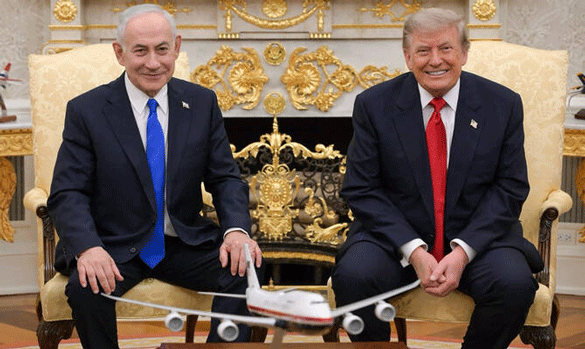
Israeli Prime Minister Benjamin Netanyahu's visit to Washington should not be viewed as just another routine diplomatic meeting between two close allies. There appears to be a striking pattern between his visits to Washington and Israel's subsequent military actions on the ground. For this reason, the meetings at the White House deserve attention not only for what they may mean for U.S.-Israeli relations, but also for their potential impact on a region stretching from Iran and Syria to Gaza and Lebanon.
Throughout his political career, Netanyahu has repeatedly demonstrated an ability to use security crises not merely as instruments of foreign policy but also as tools for strengthening his political position at home. In Israeli politics, periods of heightened external threats often reduce domestic polarization and generate greater public support for the government. Consequently, his visits to Washington should not be interpreted solely through their impact on the Middle East; they are equally important in understanding his domestic political calculations.
Conflicting U.S.-Israel interests
The 12-day war that engulfed the region last year offers one of the clearest examples of this pattern. Before the outbreak of hostilities, the Netanyahu government engaged in diplomatic consultations in Washington, arguing that Iran represented not only a threat to Israel but also a direct challenge to American interests in the Middle East. Backed by the influence of pro-Israel lobbying groups in Washington, significant pressure was placed on the U.S. administration to adopt a tougher military posture toward Tehran. Shortly afterward, the region descended into one of its most dangerous periods of military confrontation.
As the conflict unfolded, however, unexpected disagreements emerged between Washington and Tel Aviv. In particular, the U.S. administration reacted strongly after Qatar became a target. Qatar is not only home to one of America's largest military bases in the Middle East, but it also serves as a key hub for U.S. diplomacy, mediation efforts, and regional crisis management. Any action targeting Qatar therefore has implications that extend beyond Doha itself and directly affect American strategic interests.
During this period, international media widely reported that President Donald Trump summoned Netanyahu to Washington and that big differences had emerged between the two leaders. Reports also suggested that diplomatic efforts were undertaken to repair relations with Qatar and that Netanyahu was compelled to soften his position. Whether or not every detail of these reports proves accurate, the episode illustrated an important reality: despite their close alliance, the United States and Israel do not always share identical regional priorities, and Washington has at times been willing to intervene when its own strategic interests are at risk.
Nevertheless, Netanyahu's determination to keep military options on the table has never disappeared. Similar dynamics reportedly emerged before the wave of attacks that began on Feb. 28. Once again, the Israeli government launched an intensive diplomatic and political lobbying campaign in Washington. By emphasizing Iran's regional influence, its network of proxy groups, and its missile capabilities, Israeli officials sought to convince the U.S. administration that stronger military measures were necessary. Israel's security concerns were placed at the forefront of international discussions, while diplomatic solutions were increasingly portrayed as inadequate.
Today, however, the regional atmosphere appears to be evolving in a different direction. Türkiye, Qatar, Saudi Arabia, Egypt and Pakistan have all intensified diplomatic efforts aimed at preventing another major regional conflict. Recent initiatives to lower tensions across the Gulf have created renewed optimism that negotiations and dialogue could once again replace military confrontation. Although it remains too early to speak of lasting peace, there is growing hope that the current cycle of escalation can at least be contained.
Playing his card again
It is precisely at such a moment that Netanyahu's visit to Washington becomes particularly significant. Ahead of these critical talks, recent developments have already begun to expose the widening cracks in the two leaders' relationship. U.S. President Donald Trump publicly dismissed Netanyahu’s expected pressure regarding Türkiye, bluntly stating that he does not need to ask Netanyahu's permission regarding the sale of F-35 jets to Türkiye. Meanwhile, as Netanyahu doubles down on his demands to launch fresh strikes against Iran, reports indicate that Trump has signaled deep frustration with these persistent calls, making it clear in no uncertain terms: "If I want to hit Iran, I'll hit Iran myself; I don't need you to push me into it."
This growing friction underscores a broader transformation in Washington's stance. Netanyahu is no longer viewed as a welcome or favored figure in the White House, but rather as an increasingly isolated Israeli prime minister whose political survival tactics risk entangling the U.S. in unwanted regional entanglements. Given these sharp disagreements, current indicators suggest a high probability that Netanyahu will return to Tel Aviv empty-handed, lacking the carte blanche or the explicit military backing he desperately seeks from Washington.
Netanyahu's domestic problems
The Israeli prime minister faces an increasingly complicated political landscape at home. With elections expected in October, Netanyahu confronts one of the most consequential political challenges of his career. Given the uncertainties surrounding his political future, coalition dynamics and ongoing legal proceedings, securing a strong electoral victory has become not merely a political objective but a necessity.
Israel's political history over the past three decades demonstrates that periods of heightened security threats often reshape electoral dynamics. As external dangers dominate public discourse, voters tend to rally around leaders who present themselves as capable of protecting national security. Against this backdrop, arguments that Netanyahu may have a political interest in renewed regional tensions are rooted not only in political commentary but also in historical patterns within Israeli domestic politics.
His objective may extend beyond reviewing current regional developments or strengthening bilateral relations. It is entirely possible that the primary goal is to secure political backing from the Trump administration for future Israeli military initiatives. Such support would not necessarily require direct American military involvement. Even tacit approval, diplomatic protection, or strategic silence from Washington would significantly expand Israel's room for maneuver. Yet, with Washington increasingly pushing back against his unilateral demands, achieving even this diminished objective appears increasingly difficult.
Israel's next target
Israel's security strategy in recent years suggests that it no longer views regional theaters as isolated conflicts. Iran, Syria, Lebanon, Gaza, Iraq and Yemen are increasingly treated as interconnected fronts within a broader regional security framework. Consequently, any political understanding reached in Washington could pave the way for military operations in multiple arenas, even if Washington's reluctance constrains the scope of such adventures.
For this reason, close attention should be paid not only to the official statements released after the meetings but also to changes in Israeli security rhetoric, shifts in American diplomatic messaging, and military developments on the ground in the weeks ahead. In the Middle East, wars often begin not with the launch of the first missile but with the political signals exchanged behind closed diplomatic doors.
If Netanyahu's discussions instead lay the political groundwork for another military campaign, today's fragile hopes for de-escalation could quickly give way to a new cycle of conflict. What the Middle East needs is not another battlefield but stronger political mechanisms capable of resolving existing disputes through diplomacy.
As Netanyahu continues to view regional security crises as a means of advancing his political future, decisions made in Washington and the growing rift between the two capitals will shape not only Israel's strategic trajectory but also the future of the entire Middle East. For that reason, this visit should be regarded not as an ordinary diplomatic engagement, but as one of the most consequential geopolitical moments facing the region today.
https://www.dailysabah.com/opinion/op-ed/prelude-to-another-conflict-netanyahu-at-washingtons-doorstep
-------
The death count trap: Why tallying victims won’t stop Israel’s genocide
July 29, 2026
by Dr Ramzy Baroud
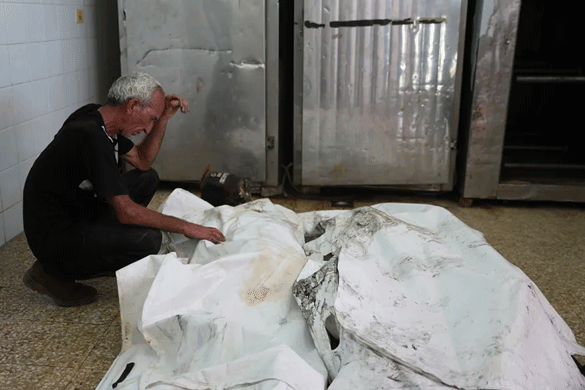
The words ‘killed’, ‘injured’, ‘maimed’, and the like often lose a great part of their meaning when they are repeated so relentlessly.
Take, for example, a headline like: “13 Palestinians Killed in Gaza, Others Wounded.” Though many of us can still feel a deep sense of sadness over such a tragedy, the news itself becomes less shocking over time.
According to figures produced by the Palestinian Ministry of Health in Gaza, Israel has killed and wounded a total of over 250,000 Palestinians since the start of the genocide in 2023.
The tally is updated daily because the killing never stops.
On July 23, six Palestinians were killed in Gaza. A day earlier, 13 were killed, and the day before that, nine others were killed, and so on.
It is this “and so on” that makes us lose our sense, over time, of what these tragedies actually entail. These are innocent people who are burned alive in their tents, bombed in their cars, or killed while attempting to enjoy a brief moment of respite from the scorching heat on the beach.
A photo circulating on social media showed three of those children: a boy wearing a T-shirt that read ‘Santa Monica Beach’; his bespectacled sister in a pink shirt, proudly holding a certificate of achievement from her school; and their youngest sister, posing gently.
These three represent every single Palestinian child killed since the start of this genocide. According to UN and international estimates, over 21,000 children have been killed in Gaza, with tens of thousands more maimed or buried under the rubble.
Though the daily routine of killing makes the tragedy feel less shocking for those merely hearing the numbers, it becomes infinitely more tragic for those who must bear it directly. In Gaza, not a single family has been spared the loss of loved ones, making the grief compound day after day.
There are no words to describe the collective pain of Gaza.
What makes the tragedy even more unbearable is that the entire world knows what has transpired and continues to transpire in Gaza, yet fails to do anything about it. We keep track of the numbers, we point to Israel’s barbarity, we decry the failure of international institutions, and we shake our heads in despair.
Yet the outcome remains unchanged: the death toll rises, and new statistics are generated daily to remind us of the magnitude of the crisis.
A July 23 joint report by the FAO, UNICEF, and the World Food Programme found that 1.4 million Palestinians in Gaza face acute food insecurity.
The report also warned that more than 74,000 children under five are expected to require urgent treatment for acute malnutrition over the coming year.
This report was released on the same day that Gaza health authorities updated the official death toll to over 73,311 Palestinians. That number is already higher now, as more have been killed since.
On that same day, Thameen Al-Kheetan of the UN Office of the High Commissioner for Human Rights (OHCHR) stated that “no place in Gaza can be considered safe.”
That statement is true, of course, but it is also the most well-known fact in the world right now. No one is contesting it. And yet, no one acts: Israel keeps bombing, the US Congress continues assigning it more weapons, and the rest of the world tracks the death tally.
Though it was never fair to begin with, even the original Trump Gaza plan never mentioned the building of interior borders, the theft of additional land, or the concentration of displaced Palestinians into tiny enclaves within an already small piece of land.
Israel’s long-term plan is not only to maintain permanent military control over Gaza, as top Israeli officials have declared, but also to prolong its torment indefinitely.
Even as I write this article, news reports indicate that four more Palestinians have just been killed. It is unlikely the number will remain that low; the Israeli army rarely kills in small numbers.
But even these small numbers represent human beings whose grief cannot be measured in statistics, summed up in official statements, or reduced to clichéd headlines.
The only difference between the past and the present is that today, we all know, see, and hear exactly what is happening in Gaza and across Palestine.
The very least we can do is refuse to turn our backs or reduce the genocide before our eyes to numbers.
If we allow that to happen, we become culpable, too: Israel does the killing, using American arms, while we sit by, counting the dead and shaking our heads at the sad state of the world.
https://www.middleeastmonitor.com/20260729-the-death-count-trap-why-tallying-victims-wont-stop-israels-genocide/
-------
The US–Iran pause in strikes: A window for sustainable peace?
July 29, 2026
by Dr Ismail Adaramola
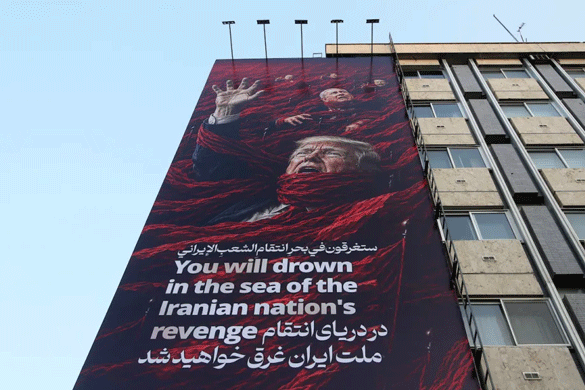
In international politics, silence can sometimes speak louder than explosions. When two long-standing adversaries such as the United States and Iran pause military strikes, the world does not simply witness a temporary cessation of hostilities—it is presented with a rare opportunity to ask a more profound question: Can this pause become the foundation for sustainable peace, or is it merely an interval before another cycle of confrontation?
The history of US–Iran relations has been marked by decades of mistrust, political rivalry, economic sanctions, proxy conflicts, and periodic military escalation. Every confrontation has reinforced narratives of insecurity on both sides, leaving diplomacy struggling to compete with strategic calculations. Yet history also teaches that even the most entrenched conflicts can change course when leaders recognise that dialogue offers greater rewards than destruction.
Instead, they often deepen resentment, destabilize societies, and create conditions for future violence. The true measure of national strength is not the capacity to wage war indefinitely but the wisdom to know when peace serves national interests better than continued confrontation.
The recent pause in strikes should therefore be viewed not as an end in itself but as a diplomatic opening. Such moments are rare because they create political space for communication without the immediate pressure of active military operations. They allow policymakers to reassess priorities, humanitarian organisations to reach affected populations, and international mediators to facilitate constructive dialogue. If managed wisely, a temporary pause can become the first step toward reducing tensions and rebuilding confidence.
Diplomacy is often criticised as slow and uncertain. Negotiations require patience, compromise, and political courage. Yet history demonstrates that durable peace agreements—from Europe to Africa and Asia—were achieved not through perpetual warfare but through sustained dialogue, confidence-building measures, and mutual recognition of legitimate security concerns.
The broader Middle East stands to gain enormously from sustained de-escalation. The region has endured decades of armed conflict, sectarian violence, humanitarian crises, and economic disruption. Every escalation between Washington and Tehran reverberates beyond their bilateral relationship, affecting neighboring states, global energy markets, international trade routes, and millions of ordinary civilians whose lives become collateral damage in geopolitical competition. Stability between the United States and Iran would therefore contribute not only to bilateral security but also to regional and international peace.
This pause also highlights the indispensable role of international institutions and middle-power diplomacy. Organisations such as the United Nations, alongside regional actors capable of facilitating dialogueue, possess an important responsibility in encouraging confidence-building measures and reducing the risk of accidental escalation. Effective diplomacy requires impartial mediation, respect for international law, and recognition that security cannot be achieved through unilateral action alone.
Equally important is the human dimension of peace. Discussions of military strategy often overlook those who bear the greatest burden of conflict: families displaced from their homes, children deprived of education, healthcare systems overwhelmed by crisis, and communities living under the constant shadow of violence.
Nevertheless, optimism must remain realistic. A pause in military operations does not automatically resolve the structural issues dividing the two nations. Disagreements concerning regional influence, security guarantees, sanctions, nuclear activities, and strategic alliances remain deeply rooted. Sustainable peace requires continuous diplomatic engagement rather than temporary tactical restraint. Without addressing these underlying issues, the current calm risks becoming only another brief interruption in a recurring cycle of escalation.
Political leaders on both sides face a fundamental choice. They can continue viewing every disagreement through the lens of military deterrence, or they can recognise that genuine security is strengthened by dialogueue, economic cooperation, and mutual respect. Choosing diplomacy is neither weakness nor concession. Rather, it reflects strategic maturity and confidence in the possibility that negotiation can accomplish what decades of confrontation have failed to achieve.
The international community also has a responsibility. Peace cannot depend solely on the decisions of two governments. Academic institutions, civil society organisations, religious leaders, journalists, and policy experts all play important roles in promoting dialogue, countering inflammatory rhetoric, and fostering public understanding across political and cultural divides. Sustainable peace is built not only in diplomatic chambers but also through people-to-people engagement that humanises former adversaries.
The greatest victories of the twenty-first century will not belong to nations that perfect the art of warfare but to those that demonstrate the courage to build peace. If this pause becomes the beginning of renewed diplomacy, strengthened international cooperation, and a sincere commitment to addressing longstanding grievances through negotiation rather than violence, it may be remembered as far more than a military pause. It may become the moment when two rivals chose dialogueue over destruction and offered the world renewed hope that lasting peace remains possible.
https://www.middleeastmonitor.com/20260729-the-us-iran-pause-in-strikes-a-window-for-sustainable-peace/
--------
Genocide Fatigue: Why Documenting the Slaughter Will Not Save Gaza
July 30, 2026
By Ramzy Baroud
The words ‘killed’, ‘injured’, ‘maimed’, and the like often lose a great part of their meaning when they are repeated so relentlessly.
Take, for example, a headline like: “13 Palestinians Killed in Gaza, Others Wounded.” Though many of us can still feel a deep sense of sadness over such a tragedy, the news itself becomes less shocking over time.
According to figures produced by the Palestinian Ministry of Health in Gaza, Israel has killed and wounded a total of over 250,000 Palestinians since the start of the genocide in 2023.
The tally is updated daily because the killing never stops.
On July 23, six Palestinians were killed in Gaza. A day earlier, 13 were killed, and the day before that, nine others were killed, and so on.
It is this “and so on” that makes us lose our sense, over time, of what these tragedies actually entail. These are innocent people who are burned alive in their tents, bombed in their cars, or killed while attempting to enjoy a brief moment of respite from the scorching heat on the beach.
Among the nine killed on July 21, an entire family, including four young children, was wiped out in a single strike. As reports of Israel’s daily harvest of Palestinian lives in Gaza multiply, journalists too often neglect to humanize those killed.
A photo circulating on social media showed three of those children: a boy wearing a T-shirt that read ‘Santa Monica Beach’; his bespectacled sister in a pink shirt, proudly holding a certificate of achievement from her school; and their youngest sister, posing gently.
These three represent every single Palestinian child killed since the start of this genocide. According to UN and international estimates, over 21,000 children have been killed in Gaza, with tens of thousands more maimed or buried under the rubble.
Though the daily routine of killing makes the tragedy feel less shocking for those merely hearing the numbers, it becomes infinitely more tragic for those who must bear it directly. In Gaza, not a single family has been spared the loss of loved ones, making the grief compound day after day.
There are no words to describe the collective pain of Gaza.
What makes the tragedy even more unbearable is that the entire world knows what has transpired and continues to transpire in Gaza, yet fails to do anything about it. We keep track of the numbers, we point to Israel’s barbarity, we decry the failure of international institutions, and we shake our heads in despair.
Yet the outcome remains unchanged: the death toll rises, and new statistics are generated daily to remind us of the magnitude of the crisis.
A July 23 joint report by the FAO, UNICEF, and the World Food Programme found that 1.4 million Palestinians in Gaza face acute food insecurity.
The report also warned that more than 74,000 children under five are expected to require urgent treatment for acute malnutrition over the coming year.
This report was released on the same day that Gaza health authorities updated the official death toll to over 73,311 Palestinians. That number is already higher now, as more have been killed since.
On that same day, Thameen Al-Kheetan of the UN Office of the High Commissioner for Human Rights (OHCHR) stated that “no place in Gaza can be considered safe.”
That statement is true, of course, but it is also the most well-known fact in the world right now. No one is contesting it. And yet, no one acts: Israel keeps bombing, the US Congress continues assigning it more weapons, and the rest of the world tracks the death tally.
Meanwhile, Israel—which has seized control of even more territory in Gaza since the so-called ceasefire—is now constructing massive earth barriers stretching an estimated 23 kilometers across the Strip.
Though it was never fair to begin with, even the original Trump Gaza plan never mentioned the building of interior borders, the theft of additional land, or the concentration of displaced Palestinians into tiny enclaves within an already small piece of land.
Israel’s long-term plan is not only to maintain permanent military control over Gaza, as top Israeli officials have declared, but also to prolong its torment indefinitely.
Even as I write this article, news reports indicate that four more Palestinians have just been killed. It is unlikely the number will remain that low; the Israeli army rarely kills in small numbers.
But even these small numbers represent human beings whose grief cannot be measured in statistics, summed up in official statements, or reduced to clichéd headlines.
Nor do survivors cling to the empty promise of international law prevailing over US-backed impunity. History has made Palestinians cynical. For generations, through every massacre and land theft since the 1948 Nakba, waiting for justice has yielded nothing but hollow promises and rising body counts.
The only difference between the past and the present is that today, we all know, see, and hear exactly what is happening in Gaza and across Palestine.
The very least we can do is refuse to turn our backs or reduce the genocide before our eyes to numbers.
If we allow that to happen, we become culpable, too: Israel does the killing, using American arms, while we sit by, counting the dead and shaking our heads at the sad state of the world.
https://www.palestinechronicle.com/genocide-fatigue-why-documenting-the-slaughter-will-not-save-gaza/
--------
Behind Closed Doors: New Footage Reveals Graham’s Role in Israel’s Regional Strategy
July 30, 2026
By Romana Rubeo
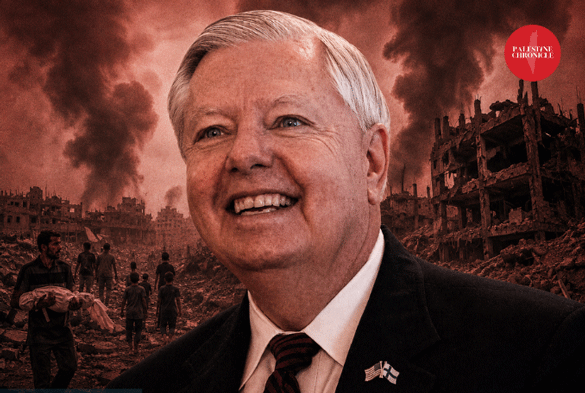
A Rare Window into American Power
Few American lawmakers have exercised the level of influence over Middle East policy that Senator Lindsey Graham enjoyed during the final years of his political career. Yet even Graham’s public image as one of Israel’s strongest allies only partially reflected the extent of his behind-the-scenes role.
That role is now emerging through more than 400 hours of previously unseen documentary footage recorded by British filmmaker Alex Holder over approximately four years for a forthcoming documentary, Lindsey’s Game.
Portions of the material, reviewed separately by CNN, The New York Times and The Wall Street Journal, offer an extraordinary portrait of Graham operating simultaneously as adviser to President Donald Trump, confidant of Israeli Prime Minister Benjamin Netanyahu, advocate for expanding the war against Iran, and intermediary between the Israeli government and members of the US Congress.
“It was pretty remarkable, and we had this four-and-a-half-year period of just the most, really unparalleled access, to one of the most consequential politicians in the United States,” Holder told CNN, describing the scope of the project.
Unlike memoirs or retrospective interviews, the footage captures conversations as they unfolded, placing viewers inside phone calls with world leaders, meetings with foreign officials and candid exchanges that reveal how policy was discussed—and, at times, actively shaped.
Netanyahu’s Closest Political Partner in Washington
The documentary’s most striking revelation is the depth of Graham’s relationship with Netanyahu.
The footage depicts a relationship extending far beyond public diplomatic engagement.
Rather than merely expressing support for Israel, Graham appears repeatedly to function as a political intermediary, coordinating messaging, discussing congressional strategy and updating Netanyahu on efforts inside Washington.
One exchange reviewed by The New York Times occurred on October 29, 2024, only days before the US presidential election and as the International Criminal Court was considering arrest warrants against Netanyahu.
During the conversation, Netanyahu urged Graham to organize congressional opposition to the court.
“I suggest that you send a letter, with, maybe some other senators,” Netanyahu told Graham.
When Graham proposed House Speaker Mike Johnson as an ideal signatory, Netanyahu immediately asked another question: “Would he get Democrats?”
Graham responded that he would attempt to build bipartisan support.
The conversation continued later that day.
“We got them both,” Graham told Netanyahu, apparently referring to Democratic Senators Richard Blumenthal and Ben Cardin.
“So here’s why I’m calling you,” Graham continued. “Send me over whatever you want to say.”
Rather than simply informing Netanyahu about congressional developments, Graham invited the Israeli prime minister to help shape the contents of the letter itself.
He then requested something in return. “I want you to call Blumenthal and Cardin and thank them for being fair-minded on this, and also thank them for trying to help with Saudi-Israel normalization.”
At another point in the same series of conversations, Graham said: “I should get tons of shekels.”
The bipartisan letter was ultimately released on November 1, 2024, bearing the signatures of both Blumenthal and Cardin alongside Republican lawmakers.
According to The New York Times, it argued that the ICC should delay action against Netanyahu while allegations against then-Chief Prosecutor Karim Khan were unresolved.
‘I Almost Cried’: Celebrating War Against Iran
If Graham’s relationship with Netanyahu forms one pillar of the documentary, the senator’s campaign for war against Iran forms another.
Throughout the footage, Graham emerges as one of the conflict’s most enthusiastic political advocates.
CNN reports that after US military operations intensified, Graham described his efforts with unmistakable pride. “It’s the best thing I’ve ever done.”
Speaking about Trump, Graham added: “He loves blowing stuff up.”
He continued: “He hasn’t tweeted much at all. No drama. He’s been a great wartime president. I said last night that Trump and Bibi are like Roosevelt and Churchill.”
The Wall Street Journal reviewed additional footage recorded immediately after US strikes on Iran.
Looking toward the documentary crew, Graham declared: “Look what we’ve done here. I almost cried.”
Moments later he added: “How long have we been pushing this?”
According to The Wall Street Journal, Graham also told the crew that Trump shared his enthusiasm. “I talked to Trump this morning, he’s jacked, he said, ‘best thing I have ever done.’ He loves blowing stuff up.”
Pushing beyond Netanyahu
Ironically, one of the documentary’s most revealing episodes suggests Graham occasionally advocated military escalation beyond what even Netanyahu considered prudent.
According to The Wall Street Journal, Graham planned to travel to Florida in early March to persuade Trump to expand military operations by directly attacking Hezbollah in Lebanon.
Before making the trip, Graham spoke with Netanyahu and the Israeli prime minister urged restraint.
“We’re concentrating right now on Iran,” Netanyahu said. “If we tell Hezbollah that we’re going all the way, we threaten them, but if we actually do it, then they have no reason not to go all the way against us. And right now that’s not our interest.”
After listening, Graham replied: “That’s actually good counsel.”
Selling the War in Washington
The documentary also portrays Graham as deeply frustrated by what he viewed as insufficient political support for the war.
Speaking to the documentary crew, he lamented: “Very few people are out selling this war from the administration. I’m shocked.”
Elsewhere, he described battling internal opposition within Trump’s circle from officials reluctant to deepen American involvement.
According to The Wall Street Journal, Graham believed stronger public advocacy was needed to sustain political momentum.
The recordings suggest he viewed himself as both strategist and salesman—someone responsible not only for shaping policy but also for persuading Congress, the media and the American public to embrace it.
Graham’s Parallel Foreign Policy
Beyond Iran and the ICC, the documentary portrays Graham operating as an unofficial diplomatic channel spanning multiple capitals.
According to The Wall Street Journal, Holder filmed Graham traveling to Saudi Arabia to meet Crown Prince Mohammed bin Salman, speaking with Mossad officials, consulting military commanders, discussing Ukraine with President Volodymyr Zelensky, and maintaining regular contact with Netanyahu.
Holder told the newspaper that Graham himself often marveled at the access he possessed.
He described the senator joking that he could reach President Trump more easily than he could reach the filmmaker.
At another point, Graham discussed negotiations involving Iran with former National Security Adviser Jake Sullivan. “I can’t do it with Jared, and I can’t do it with Witkoff. They’re just too conflicted. It’s gotta be Rubio.”
Predictions that Never Materialized
The documentary also captures the limitations of Graham’s strategic assessments.
Speaking with Sullivan in March, Graham confidently predicted the rapid collapse of Iranian resistance.
“In three to four weeks, we should have them in a spot where they start losing control of some cities … get the Arabs more openly involved tomorrow, or by the end of the week, and then have almost irreversible momentum,” he is heard saying.
Both CNN and The Wall Street Journal note that these expectations proved dramatically inaccurate.
Rather than quickly collapsing, the war prolonged, while several anticipated political developments failed to materialize.
“There’s No Way I Can Die Yet”
The documentary concludes with a portrait of Graham convinced that multiple geopolitical projects depended on his continued involvement.
According to the filmmaker, Graham believed he still needed to complete several historic tasks, including defeating Iran, helping broker normalization between Saudi Arabia and Israel, and advancing other diplomatic initiatives.
“He’d say, ‘There’s no way I can die yet,'” Holder recalled.
The remark serves as a fitting conclusion to footage depicting a politician who viewed himself not simply as a senator but as a central actor in shaping the Middle East.
https://www.palestinechronicle.com/behind-closed-doors-new-footage-reveals-grahams-role-in-israels-regional-strategy/
--------
From Genova to Gaza — Twenty-Five Years after the State Murder of Carlo Giuliani
July 30, 2026
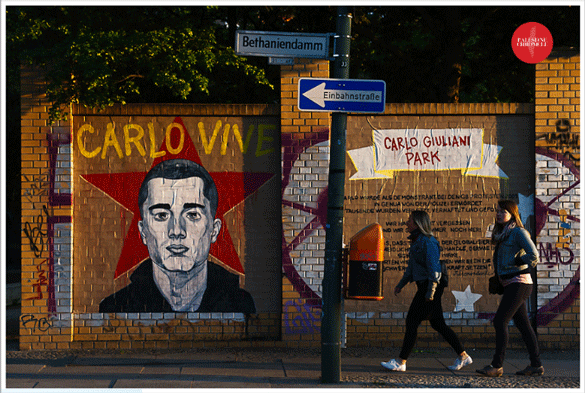
On July 20, 2001, in the historic port city of Genova, the global ruling class met behind the Red Zone while the Italian state showed the world exactly how far it would go to protect them. Silvio Berlusconi played host to George W. Bush, Tony Blair, and the rest of the G8. Outside, hundreds of thousands of people from every corner of the planet had gathered to declare that another world is possible. Among them was Carlo Giuliani, twenty-three years old, the son of a CGIL trade-union militant, raised in a family that understood class struggle as a living tradition.
What happened that day—and in the nights that followed—was not a “clash.” It was a deliberate, coordinated suspension of the rule of law. Italian and international police turned the streets into a war zone. Residents watched as young people on their way to the beach were beaten in clouds of tear gas. Old women and shopkeepers were attacked simply for being on their own streets. The New World Order, cornered by a rising global movement, lashed out with the ferocity of a wounded beast.
In the many conversations I have had over the years with Italians who were there that week, a common thread always emerges. They speak of a sensation that is almost impossible to describe unless you lived it: the sudden, total suspension of the basic rights of individuals to protest, to gather, even to walk the streets of their own city. The rule of law itself was set aside. Police forces were given full reign to be as violent as they wanted, with the open support of the Italian state and the world leaders gathered behind the barriers. After the Battle of Seattle two years earlier — the uprising so powerfully documented by Jeffrey St. Clair and Alexander Cockburn in 5 Days That Shook the World — it felt as if a lesson had to be taught to the international movement from below: a crushing blow delivered, fear deliberately instilled. The message was unmistakable: this far, and no further.
Carlo was one of those who fought back. When the Carabinieri jeep found itself surrounded in Piazza Alimonda, he picked up a fire extinguisher. A shot rang out from inside the vehicle. The bullet struck him in the head. Then the jeep ran over his body—backwards and forwards. He was left to die on the pavement while the leaders of the richest nations on earth continued their lunch.
I wrote about this on the tenth anniversary. The facts have not changed. The photographs still show the gun pointed at Carlo’s head. The official story—that the bullet “ricocheted”—was always a transparent cover-up. Mario Placanica, the carabiniere who fired the shot, was never put on trial. He was later promoted. The courts protected the chain of command.
That same night and the next, the state completed its lesson. Police stormed the Armando Diaz school, where activists and independent journalists were sleeping. What they did there has been described by one of their own as a “Mexican butcher shop.” Bones were broken. Faces were smashed. Blood covered the floors. Evidence was planted. Then the survivors were taken to the Bolzaneto barracks, where the real torture chamber waited: beatings, forced fascist songs, threats of rape, people forced to stand for hours in their own urine and blood, medical staff who participated in the humiliation. This was not rogue violence. This was policy. This was the Italian state, acting on behalf of the global elite, teaching an entire generation what happens when you challenge the order of capital and empire.
Twenty-five years later, Genova remembered:
On July 19, 2026, a national corteo of between five and ten thousand people wound through the same streets. They started near the Diaz school, where a banner proclaimed “Don’t clean up this blood – nessuno cancelli questo sangue.” They moved through Via Tolemaide, site of the first major police charges in 2001, past the headquarters of CasaPound—where activists of Genova Antifascista erected a symbolic plasterboard wall declaring the area a “zona denazificata”—and on to Piazza De Ferrari. Smoke filled the air. The central slogan was clear and unapologetic: “In ogni caso nessun rimorso” — In any case, no remorse.
The next day, July 20, the crowd returned to Piazza Alimonda itself. Organized by the Comitato Piazza Carlo Giuliani under the motto “Chi non ha memoria non ha futuro” (Whoever has no memory has no future), the gathering titled “Per non dimentiCarlo” – To NotForgetCarlo filled the square with speeches, music, and testimony. Flowers were laid at the memorial. An extinguisher was placed on it — the same object Carlo had held in the final seconds of his life. At 17:27, the exact minute of the shooting, the piazza fell silent.
Elena Giuliani, Carlo’s sister, spoke with the clarity of someone who has carried this wound for a quarter of a century. “I temi di allora sono ancora tutti terribilmente, tragicamente presenti oggi,” she said—the themes of then are still all terribly, tragically present today. Wars. The genocide in Palestine. Climate collapse. Repression in the streets, in the prisons, in the migrant detention centers, at the borders. She pointed to a recent George Floyd style killing of a Moroccan immigrant named Abderrahim Fakir under police restraint in Bologna and drew the straight line: “La repressione di allora continua… Quello che noi chiedevamo allora è ancora valido ed estremamente necessario.” The repression of then continues. What we asked for then is still valid and extremely necessary. There was never a trial for her brother’s killing. The case was dismissed quickly. She demanded institutional responsibility and an end to the culture of impunity.
Participants unrolled a long white sheet across the square, transforming it into a collective shroud. A text inspired by Paola Caridi’s work on Gaza was read aloud, insisting that not a single name be forgotten. Activists from the Freedom Flotilla Italia and Global Sumud Flotilla stood among them. The crowd answered with the old chant, renewed for a new generation: “Carlo è vivo e lotta insieme a noi, le nostre idee non moriranno mai” — Carlo is alive and fights together with us; our ideas will never die. In that moment the memory of Genova 2001 fused, without apology or hesitation, with the struggle against the ongoing genocide in Palestine.
This is the sentiment of those who were there and those who have taken up the torch. Not nostalgia. Not passive mourning. A living, political refusal. The people who walked the corteo and filled Piazza Alimonda understand that the suspension of the rule of law in July 2001 was not an aberration. It was a demonstration of the permanent readiness of the capitalist state to use lethal force and systematic torture when the movements of the exploited and the oppressed grow too strong. The same logic that protected Bush, Blair, and Berlusconi now protects the architects of the war on Gaza, the privatizers, the climate destroyers, and the new fascist currents rising across Europe.
Carlo Giuliani was killed for resisting an unjust system that places profit and empire above human life. His mother, Haidi Giuliani, has described him simply and powerfully: “Mio figlio, con la sua canottiera, è una figura fragile che si ribella alla prepotenza” — My son, with his tank top, is a fragile figure who rebels against arrogance. In Palestine, that same system has claimed thousands upon thousands of lives — children, journalists, medics, students, entire families — whose only crime was to refuse disappearance, to insist on remaining on their land, to resist. The fire extinguisher in Piazza Alimonda and the rubble of Gaza are not separate stories. They are chapters of the same book. The Italian state that ran Carlo over to protect the G8 is the same state that today facilitates the arms shipments and political cover enabling the slaughter. The movement that gathered in Genova this July understood this clearly: the fight against capitalist globalization and the fight for Palestinian liberation are one struggle.
The murder of Carlo Giuliani was never just about one young man and one bullet. It was the moment the mask slipped. The global elite, meeting in luxury while the planet burned and the poor were crushed, authorized the Italian state to show us the price of resistance. They wanted us to be afraid. They wanted the movement that had grown from Seattle to Genova to scatter and die.
It did not die.
Twenty-five years later, the fire extinguisher still rests on the memorial in Piazza Alimonda. The jeep still rolls over the body in the photographs. And the people who were there — and the people who have come after — still refuse the order that required Carlo’s death to protect itself. In Genova this year they made the connection explicit: from Piazza Alimonda to Gaza, the same system, the same resistance, the same demand that another world is possible.
Carlo lives because the struggle he died in continues. Palestine lives because its people refuse to die. Another world is still possible. And the state that killed him, and that enables the killing of so many others, still has blood on its hands.
https://www.palestinechronicle.com/from-genova-to-gaza-twenty-five-years-after-the-state-murder-of-carlo-giuliani/
--------
Report Warns Gaza’s Mothers Face ‘Reproductive Violence’ under Israeli Genocide
July 29, 2026
‘Reproductive Violence’
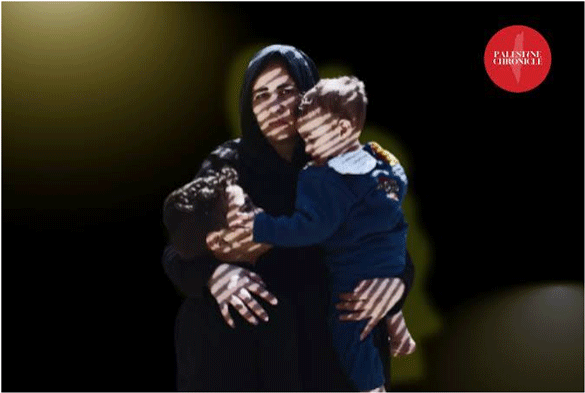
A new report has warned that Israel’s ongoing genocide in the Gaza Strip is inflicting catastrophic harm on pregnant women, breastfeeding mothers, and newborns, leaving pregnancy increasingly dependent on “luck rather than care.”
Published by the UK-based Palestinian Return Centre (PRC), the report, Pregnancy Under Fire: Reproductive Violence and the Destruction of Maternal Life in Gaza, draws on data from United Nations agencies and international humanitarian and medical organizations to document what it describes as the systematic destruction of maternal healthcare in the besieged enclave.
According to the report, the consequences of the genocide will extend far beyond the current military assault, with malnutrition, forced displacement, and psychological trauma likely to shape the health and development of an entire generation of Palestinian children.
A War that Begins before Birth
The report argues that the impact of Israel’s military campaign reaches into the earliest stages of life, affecting children before they are even born.
Thousands of pregnant women, it says, are carrying pregnancies under conditions of repeated displacement, bombardment, hunger, and the near-total collapse of healthcare services.
Citing figures from the United Nations Population Fund (UNFPA), the report projects that approximately 55,000 pregnant and breastfeeding women in Gaza will face severe malnutrition by mid-2026—more than three times the estimated 17,000 recorded a year earlier.
It also notes that one in every five babies born in Gaza is now either premature or underweight.
Maternity Services in Collapse
According to the report, Gaza’s maternity care system is in a state of “functional collapse.”
Of the Strip’s 37 hospitals, only 20 remain partially operational, and none is functioning at full capacity because of repeated attacks, fuel shortages, and the lack of medicines, blood supplies, and essential medical equipment.
As a result, many women are forced to give birth without anesthesia, skilled medical assistance, or basic sanitary conditions, often inside overcrowded displacement shelters or makeshift facilities.
“The line between survival and death has never been thinner,” the report states.
Malnutrition Threatens Mothers and Infants
The report identifies maternal malnutrition as one of the gravest threats facing women and newborns.
According to data from Save the Children cited in the study, 323 of 747 women screened during the first half of July were found to be malnourished—nearly half of those examined.
It also references a Médecins Sans Frontières (Doctors Without Borders) study following 201 mothers whose babies required neonatal intensive care between June 2025 and January 2026.
More than half of those women had suffered from malnutrition during pregnancy.
Among their infants, 90 percent were born prematurely, 84 percent had low birth weight, and mortality was twice as high as among babies born to adequately nourished mothers.
Long-Term Consequences
Beyond the immediate physical dangers, the report warns that the psychological effects of constant bombardment, displacement, bereavement, and hunger may have lifelong consequences.
It notes that prolonged exposure to severe stress during pregnancy can interfere with fetal development, potentially affecting children’s neurological, physical, and emotional health well into adulthood.
“The violence being inflicted today is being converted into biological harm that could follow children for life,” the report argues.
Echoing UN Warnings
The findings reinforce repeated warnings issued by the United Nations Population Fund, which has said that women and girls across the occupied Palestinian territory are facing rapidly deteriorating conditions due to the humanitarian crisis, movement restrictions, escalating violence, and chronic funding shortages.
UNFPA has repeatedly warned that the collapse of reproductive healthcare in Gaza is placing tens of thousands of women and newborns at immediate risk, while threatening the long-term health and resilience of Palestinian society.
The PRC report concludes that the destruction of maternal healthcare in Gaza is not simply a humanitarian emergency but a form of reproductive violence, with consequences that will continue to unfold long after the bombs stop falling.
https://www.palestinechronicle.com/report-warns-gazas-mothers-face-reproductive-violence-under-israeli-genocide/
------
New Age Islam, Islam Online, Islamic Website, African Muslim News, Arab World News, South Asia News, Indian Muslim News, World Muslim News, Women in Islam, Islamic Feminism, Arab Women, Women In Arab, Islamophobia in America, Muslim Women in West, Islam Women and Feminism