
Middle East Press On: Turkey-Malaysia Relations, Iran, Trump, American Power, China’s Quiet Hedging Strategy, Saudi Arabia, Europe, Gulf Helsinki, Washington, New Age Islam's Selection, 18 May 2026

By New Age Islam Edit Desk
18 May 2026
2026-2035: Türkiye's battle with demographic decline
Overcoming obstacles in Türkiye-Malaysia relations
Iran, Trump, and the cracks in American power
Iran: China’s quiet hedging strategy in the Middle East
Saudi Arabia is pulling Europe toward a “Gulf Helsinki” deal with Iran — because Washington failed
Western Media Complicity in Zionist War Crimes is Betrayal of Journalism 101
------
2026-2035: Türkiye's battle with demographic decline
BY FATMA ZEHRA LALEOGLU
MAY 18, 2026

Population size and demographic composition are strategic variables shaping a country's long-term trajectory as profoundly as economic performance or foreign policy. Demography influences a nation's productive capacity, social security balance, family-society structure and state resilience. For many years, Türkiye has benefited from a young and dynamic population, but the country now stands at the crossroads as its population structure is changing decisively.
Declining fertility rates, a growing elderly share and shifts in family structures are likely to become defining issues of the coming decades. Against this backdrop, President Recep Tayyip Erdogan's designation of 2026-2035 as the "Decade of Family and Population" should be understood as an expression of long-term strategic foresight.
Demographic exhaustion
Türkiye's total fertility rate has been on a sustained downward trajectory for years. Its fall below the replacement threshold signals a structural transformation rather than a temporary fluctuation. Simultaneously, the elderly share of the population is rising rapidly. The proportion of citizens aged 65 and above climbed from 5.7% in 2000 to 11.1% in 2025, and projections indicate that this trend will continue.
What is particularly noteworthy is not aging itself but the pace at which it is occurring. While many countries experienced similar transitions over the course of half a century, Türkiye is confronting a comparable demographic shift within a far shorter timeframe, placing greater pressure on economic adjustment mechanisms and institutional adaptation capacity.
This rapid, compressed transformation may be conceptualized as “demographic exhaustion”: the risk of becoming an aging society before sufficient prosperity has been achieved, institutional systems are fully prepared and the necessary social infrastructure has been consolidated. The core challenge is therefore a shrinking working-age population, mounting pressure on pension systems, rising demand for care services, increasing numbers of elderly people living alone and shifting intergenerational balances.
Dimensions of crisis
These developments signal that Türkiye must move beyond conventional population debates. Demography is no longer a purely social concern. It has become a matter of political economy, development strategy and national capacity.
Discussions of growth, investment and production typically focus on capital, technology and finance. Yet the essential driver of all these factors remains human capital. A contracting working-age population implies downward pressure on productive capacity, intensifying demands for productivity gains and new vulnerabilities in labor markets.
In aging societies, pension burdens rise, healthcare expenditures increase and the ratio of active workers to dependents deteriorates, necessitating reforms across both the public and private sectors.
Aging also reshapes physical and social infrastructure requirements: more hospitals, care centers, accessible urban environments, long-term health care systems and expanded social support mechanisms are all needed. Because the priorities of younger societies differ fundamentally from those of older ones, demographic transformation reconfigures public policy agendas across housing, transportation, employment incentives and local governance planning.
Regional disparities within Türkiye must also be taken into account. Some provinces may age gradually, while others face rapid aging or outright population decline, differences that require differentiated approaches to internal migration management, service delivery and regional development.
A further dimension concerns changing lifestyles. Household sizes are shrinking, the average age at marriage is rising, single-person living arrangements are becoming more common and everyday contact between generations is diminishing. The result is greater social isolation, weaker communal ties and thinner networks of solidarity. Yet the family remains one of society's most powerful resilience mechanisms in times of crisis. Therefore, its weakening reduces the broader capacity of society to endure adversity.
Türkiye's population challenge is thus not simply a question of how many citizens it will have in future decades. It is a question of what kind of economy it will sustain, what kind of social order it will preserve, and what type of state capacity it will be able to build.
'Decade of family and population'
In certain policy domains, decisions made today yield visible effects not tomorrow but decades hence. Population policy must therefore be approached through long-term statecraft. In this regard, the designation of 2026-2035 as the "Decade of Family and Population" represents a timely and significant step. It signals that family and population issues are being treated as strategic priorities.
On the other hand, in contemporary societies, the family is often perceived as merely a private or cultural institution. However, it is the nucleus of the care economy, the foundation of intergenerational solidarity, the primary setting for child-rearing and the first locus of belonging. During economic crises, natural disasters, pandemics, wars and social disruptions, families typically become the primary units of mutual support. Strengthening the family is therefore not only a cultural preference but a rational strategy for building societal resilience.
At the same time, reducing family and population policy to the issue of fertility decline alone would be insufficient. Marriage decisions, housing costs, women's employment, care services, urban living conditions, working hours and expectations about the future all shape demographic behavior. The appropriate response must therefore move beyond numerical targets and situate population policy within a holistic, family-centered life ecosystem.
What does policy framework say?
The policy framework reveals that demographic transformation is a multi-layered process encompassing cultural, digital and cognitive dimensions. Addressing cultural trends, addictive behaviors and harmful media content that negatively affect family and population structures within a comprehensive policy framework.
Another important dimension of the framework is its emphasis on institutional capacity and data production. Regular monitoring of changes in family and population structures, strengthening strategic data generation, encouraging academic research and ensuring centralized coordination all aim to enhance continuity and measurability in this field.
The framework also seeks to address rural depopulation, encourage reverse migration from urban to rural areas and promote the transformation of urban spaces through a family- and child-centered perspective. This is particularly important in terms of addressing internal demographic imbalances and incorporating a regional dimension into national population policy.
Finally, it envisages the strengthening of Türkiye’s leadership role in family and population issues through international cooperation and diplomacy with like-minded countries. This is especially significant given that declining fertility and population aging are not unique to Türkiye. Cooperation in these areas, through the sharing of best practices, joint research platforms and the exchange of experience, can provide important gains for Türkiye.
The directive provides a solid foundation for addressing demographic challenges, but complementary measures will be crucial.
What Türkiye needs
At this stage, the localization of population policies emerges as a key priority. Türkiye’s demographic structure is not homogeneous, while some regions maintain a high concentration of young population, others experience rapid aging and population decline. Therefore, moving beyond national policies toward regionally differentiated strategies is essential. The inclusion of local governments, universities and other institutions in data-driven cooperation will enhance policy effectiveness.
Moreover, the relationship between family policy and economic policy must be strengthened and made more direct. Decisions regarding marriage and childbearing today are shaped by both cultural preferences and economic feasibility. Factors such as housing prices, rental pressures, income stability and job security directly influence individuals’ decisions to form families.
Additionally, the tension between modern working and family life remains a critical factor shaping demographic trends. In particular, the balance between women’s participation in the workforce and childbearing decisions is a critical issue in many countries. Although extending maternity leave to 24 weeks is an important step, expanding flexible working arrangements, institutionalizing care services, and strengthening childcare infrastructure remain crucial.
In conclusion, Türkiye stands at a critical crossroad where demographic exhaustion has not yet reached an irreversible stage. However, delayed intervention would significantly increase future costs. The policy framework introduced under the “Decade of Family and Population” provides a comprehensive and institutional response at this juncture. However, its effectiveness will depend on its integration with broader domains such as economic policy, labor markets, local governments, urbanization, and social structure. Ultimately, the issue is less about demographic scale and more about the societal model and state capacity that Türkiye seeks to develop over the coming decades.
https://www.dailysabah.com/opinion/op-ed/2026-2035-turkiyes-battle-with-demographic-decline
-----
Overcoming obstacles in Türkiye-Malaysia relations
BY TARIK GÜNGEN
MAY 17, 2026

Last month, Defence Services Asia (DSA) and NATSEC Asia 2026, ranked among the world’s top five defense exhibitions, were held biennially in Kuala Lumpur, Malaysia, with 1,456 companies from 63 countries in attendance. I had the chance to experience this grand event firsthand as one of more than 40,000 visitors. As a Turkish national, I was both amazed and inspired by the remarkable level of participation from the Turkish side. Although the Chinese side led with 192 participating firms, Türkiye undoubtedly stole the spotlight with its 87 companies, especially since the Turkish giant Aselsan was the official corporate sponsor of the DSA.
At the center of the four-day event stood a full-scale mockup of Turkish Aerospace Industries' (TAI) domestically produced Hürjet jet trainer/light attack aircraft, which became the exhibition’s main symbol, almost like a monument to Türkiye’s pivot toward the Southeast Asian region. The mockup garnered enormous attention from visitors and high-ranking individuals, including Malaysian Prime Minister Anwar Ibrahim, who personally signed it.
This attention was not without reason, as the exhibition was accompanied by the signing of eight major agreements and several high-profile contracts between the Turkish and Malaysian sides, with total deal values reaching hundreds of millions of dollars.
On the third day of the exhibition, I had the opportunity to attend a nearby conference on bilateral cooperation between the two countries, organized by TAI. During the event, a keynote address by TAI CEO Mehmet Demiroglu drew particular attention to the intriguing nature of the Turkish-Malaysian relationship.
Specifically, the phrase he used to characterize the relationship was "not competing but complementing visions." He further added, "You need new aircraft and we have the aircraft, while you have the semiconductor industry that our aircraft requires."
After highlighting the progress TAI has made in Malaysia, he concluded the keynote address by saying, "We have all the ingredients we need, so what are we waiting for?"
What are we waiting for?
During the nearly two years I have spent in Malaysia, I have found myself asking the same questions repeatedly. In one of my previous articles for Daily Sabah, I also noted that there do not seem to be any obstacles standing in the way of rapprochement between the two countries. While it makes me glad to see that others are becoming more aware of the carefully arranged nature of this potential alliance, I worry that I might be noticing a pattern.
Earlier last month, the prominent think tanks of both countries, the Foundation for Political, Economic and Social Research (SETA) and the Institute of Strategic and International Studies (ISIS) Malaysia, held a joint summit as part of the "2026 Kuala Lumpur-Ankara Dialogue," in which I also participated. The most significant takeaway from the forum was that, despite the high compatibility between the two countries, insufficient information about each other and general disinterest remain the greatest obstacles to improving bilateral relations.
My personal experience over the past two years seems to confirm this, particularly as I became more familiar with the inner workings of these relations. I have received insights from multiple individuals and organizations regarding the true nature of diplomatic and defense industry dynamics.
On both the public and leadership levels, there appears to be a sincere intent to deepen relations, but the actual brokers and middlemen behind the scenes find the promotion of Turkish-Malaysian ties compelling. Despite the encouragement and the deepening of relations, numerous Turkish firms in Malaysia often find themselves competing on an uneven playing field against other foreign firms with greater production capacities and market shares. Turkish firms faced competition from American, European, Korean and Chinese firms.
According to publicly available data, such as the Stockholm International Peace Research Institute (SIPRI) and United Nations reports, there has been a genuine improvement in the share of Turkish imports in Malaysia, with Türkiye providing 10.9% of broader sector imports, making it Malaysia's third-largest defense exporter, while the U.S. leads with 15.4%. The Turkish share has likely improved over the past three years.
However, while Türkiye has established itself as a significant presence, such figures do not mask the struggles behind the scenes that undermine the efforts of Turkish companies to compete fairly in the defense sector. The most significant conflicts, particularly in the high-end product sector involving jets and battleships, often extend beyond the establishment of amicable relations with high-ranking government officials, a relationship the Turkish side already maintains.
In this regard, Malaysia is not an isolated case. Similar struggles are occurring in other countries with comparable positions, such as Indonesia, Pakistan and others.
As I mentioned in my previous article, the potential for Turkish-Malaysian relations goes beyond simplistic notions of middle-power solidarity. It is primarily a matter of strategic procurement. Both Türkiye’s and Malaysia’s trade with other countries is often dominated by nations with which they have historical or ongoing conflicts.
For Türkiye, despite years of outreach to other parts of the world, trade remains reliant on countries such as the U.S., Russia and Germany, nations from which Türkiye seeks to distance itself to increase its autonomy. In Malaysia’s case, the situation is similar: The country’s technological and economic reliance on China for key systems and industries is undeniable, even as China continues to clash with Malaysia over disputed maritime territories in the South China Sea.
How to break chains?
Then how should we break free from the chains of overtrading that give less amicable countries leverage over us?
In this regard, both Türkiye and Malaysia, perhaps the entire developing world, must adopt strategic procurement as a national ideology and collectively seek new alternatives in virtually every field, including defense products.
Lessons must be drawn from other countries in the developing and Islamic world that have lost influence and leverage over time. Some nations, due to misaligned policies, acquisitions and borrowings that contradict their strategic interests, allowed others to gain leverage over them, ultimately resulting in a significant reduction of their strategic autonomy. In many cases, what was initially regarded as amicable economic aid and business opportunities ultimately proved to be potential leverage, as the true motives of the benefactors became apparent.
For this reason, Türkiye and Malaysia must not neglect to explore alternative channels to avoid dependence on a single source. Failing to do so could be described as "strategic suicide." They must be more assertive in their strategic planning if they are sincere in their aims for greater self-reliance and the ability to act autonomously. Key policymakers must consistently remind themselves of the long-term costs of excessive dependence on others if they hope to achieve genuine strategic autonomy in the future.
https://www.dailysabah.com/opinion/op-ed/overcoming-obstacles-in-turkiye-malaysia-relations
-----
Iran, Trump, and the cracks in American power
May 17, 2026
by Ranjan Solomon
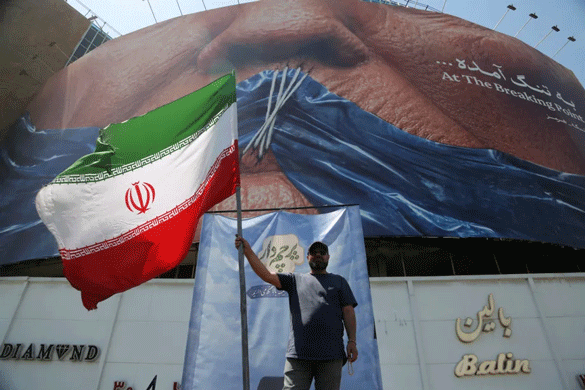
If there is one thing that now appears irreversible, it is that Iran did not lose this war and that the United States and Israel have collectively looked irrational and overconfident in their predictions. The assumption that overwhelming military pressure would quickly subdue Tehran has not materialised. Instead, the conflict has exposed the limits of American coercive power in West Asia and revealed the dangers of strategic arrogance dressed up as certainty. It increasingly appears that Washington’s room for manoeuvre is constrained by Benjamin Netanyahu’s escalation strategy and the influence of the pro-Israel lobby within American politics.
For decades, Washington relied on military superiority, sanctions, diplomatic intimidation, and regional alliances to discipline adversaries into submission. Iran, however, neither collapsed internally nor retreated strategically. Tehran demonstrated that it possesses the ability to absorb punishment while retaining retaliatory capacity through missiles, regional alliances, proxy networks, and the strategic leverage associated with the Strait of Hormuz. This does not diminish the severe economic and human costs borne by ordinary Iranians under prolonged confrontation and sanctions.
Washington would almost certainly have explored backchannel pressure through actors such as China and Gulf intermediaries to prevent further escalation around the Strait of Hormuz.
The primary face-saving strategy available to Donald Trump is to declare victory by claiming that American military operations, including targeted strikes, achieved their intended objectives. Such an approach allows him to frame the end of the conflict as a calculated success rather than a retreat. Trump is likely to follow a familiar political pattern: loudly proclaiming success while simultaneously moving toward hurried negotiations behind the scenes. His administration will attempt to present the outcome to his political base as proof of strong leadership, even if critics interpret it as strategic withdrawal under pressure.
Yet Trump faces a profound domestic contradiction that weakens his political room for manoeuvre. His political identity was built around promises to avoid “forever wars” and prioritise American economic recovery over costly military adventures abroad. A prolonged confrontation with Iran directly undermines that promise. Rising fuel prices, instability in global shipping routes, inflationary pressures, and growing public anxiety could rapidly erode support even among sections of his nationalist base. What may initially be marketed as patriotic strength can quickly come to be seen as reckless adventurism if ordinary Americans begin to experience sustained economic pain.
The deeper problem for Washington is that this conflict has reinforced a growing global perception that military supremacy alone no longer guarantees political outcomes. Across much of the Global South, Iran’s ability to withstand sustained pressure from both the United States and Israel has weakened the image of Western strategic omnipotence.
Such a framework would likely involve limited sanctions relief tied to maritime security guarantees and the stabilisation of shipping routes through the Strait of Hormuz. Trump could then present the outcome as a deal-maker’s success rather than a prolonged military entanglement.
But even this route carries risks. Beijing’s growing role as a potential mediator signals a changing geopolitical landscape in which the United States no longer enjoys a monopoly over diplomacy in the Middle East. If China, alongside regional actors such as Pakistan, Turkiye, or Gulf states, becomes instrumental in de-escalation efforts, Washington risks appearing less like the architect of peace and more like a reluctant participant compelled toward compromise. For a leader such as Trump, who thrives politically on projecting dominance and control, such optics are deeply uncomfortable.
Across much of the Global South, the conflict is being interpreted not merely as another Middle Eastern war but as evidence of a changing international order. Countries long subjected to sanctions, intervention, or Western diplomatic pressure increasingly view Iran’s endurance as symbolic of a broader resistance to unipolar power. Whether governments openly admit it or not, the perception that American coercive dominance can now be challenged carries enormous psychological and diplomatic significance.
Trump may also attempt to pressure allies, particularly Israeli Prime Minister Benjamin Netanyahu, to reduce hostilities against Iran and Hezbollah while framing the move as a courageous effort to restore peace in the region. Yet this is where the contradictions within the U.S-Israel alliance become increasingly visible. The relationship between Netanyahu and the American administration shows signs of growing friction and shifting leverage, with divided opinions emerging over who ultimately shapes the direction of regional strategy.
Netanyahu has pursued an aggressive military approach across multiple fronts – Gaza, Lebanon, Syria, and Iran – often disregarding international pressure and repeated calls for restraint. Many analysts argue that Netanyahu has increasingly prioritised the survival of his coalition government and his own political future over immediate peace settlements. Military escalation, in this reading, has become both a strategic doctrine and a mechanism for domestic political survival. Netanyahu has also been associated with spoiling tactics that undermine negotiations at sensitive moments, including targeted assassinations or escalatory actions designed to derail diplomatic openings and reinforce more confrontational approaches.
Israel’s regional priorities do not always align with Washington’s wider global calculations. While Netanyahu’s government appears prepared to sustain prolonged confrontation to preserve military dominance and political survival, the United States must simultaneously manage tensions involving China, Russia, fragile global markets, and domestic economic pressures. The result is a growing perception that Washington is increasingly reacting to escalation rather than directing it.
Israel nevertheless remains deeply intertwined with the United States through extensive military, economic, technological, and diplomatic partnerships. Long-term military aid agreements, intelligence sharing, and cooperation on missile defence systems create a foundational level of interdependence that neither side can easily abandon. Washington also continues to provide Israel with crucial diplomatic backing in international institutions, frequently shielding it from growing international criticism and legal scrutiny. These ties ensure that bilateral stability remains a strategic priority even during periods of visible disagreement.
Far from restoring unquestioned American authority, the conflict has exposed fractures in Western credibility and limitations in military power. The assumption that forces alone can reorder political realities in West Asia now appears far less convincing than it once did.
The relationship between an Israeli Prime Minister and the United States administration has always involved a complex interplay of domestic political compulsions, strategic dependency, and mutual influence. While Israeli leaders often make tactical decisions based on coalition pressures and national security calculations, those decisions are inevitably weighed against the strategic importance of the American partnership. Rather than one side permanently holding all the cards, the relationship is better understood as one of continuous negotiation, leverage, and periodic tension in pursuit of overlapping – but not always identical – regional objectives.
The U.S -Israel relationship has always involved negotiation, dependency, and periodic tension shaped by overlapping – but not identical – strategic interests. Israeli domestic politics and American global priorities frequently intersect, but they do not always move in the same direction.
https://www.middleeastmonitor.com/20260517-iran-trump-and-the-cracks-in-american-power/
------
Iran: China’s quiet hedging strategy in the Middle East
May 17, 2026
by Eko Ernada
China’s growing engagement with Iran increasingly reveals that Tehran is no longer merely a regional issue confined to Middle Eastern politics. Iran has become part of Beijing’s wider geopolitical calculation in an era shaped by intensifying great-power rivalry and a rapidly shifting global order.
Recent meetings between Iranian Foreign Minister Abbas Araghchi and Chinese Foreign Minister Wang Yi in Beijing reflected more than routine bilateral diplomacy. China once again emphasised the importance of regional stability, the security of global energy routes, and the need to keep the Strait of Hormuz open for international trade. At the same time, discussions involving Iran and the broader Middle East have become deeply intertwined with strategic conversations between China and the United States over trade competition, maritime security, Taiwan, technological rivalry, and the future balance of power.
Most international commentary still interprets China’s Middle East diplomacy largely through economic pragmatism: energy security, oil imports, and the protection of trade routes essential to China’s economy. While these explanations are important, they are insufficient to explain why Beijing has become increasingly active in Middle Eastern diplomacy precisely when pressure from Washington continues to intensify over Taiwan, semiconductor restrictions, the South China Sea, and trade disputes.
There is a deeper strategic logic behind China’s behaviour — one that can be understood through the concepts of hedging and indirect geopolitical competition.
In international relations, hedging refers to a strategy whereby states avoid fully aligning with one side while simultaneously refraining from outright neutrality. Instead, they maintain relationships with multiple actors in order to preserve strategic flexibility and minimise long-term geopolitical risks. Traditionally, hedging has been associated with middle powers navigating competition between larger states. Yet China has transformed hedging into an instrument of global power projection.
Beijing appears fully aware that direct confrontation with the United States would be extraordinarily costly, both economically and militarily. Consequently, China does not always challenge Washington directly. Rather, it seeks to shift the arena of global competition toward regions where it can accumulate diplomatic legitimacy, economic influence, and political goodwill without triggering open military confrontation.
This strategic ambiguity echoes the classical realist tradition in international relations. Hans Morgenthau argued that states ultimately pursue survival and influence within an anarchic international system. However, unlike the overt military balancing associated with Cold War geopolitics, China’s contemporary strategy reflects a more adaptive and indirect form of realism. Beijing expands influence gradually through diplomacy, connectivity, and economic interdependence rather than direct coercion.
In many ways, China’s behaviour also reflects the logic of classical Chinese strategic thought. Sun Tzu’s The Art of War famously argues that “the supreme art of war is to subdue the enemy without fighting.” Although often quoted superficially, this principle remains highly relevant in understanding China’s geopolitical conduct today. Beijing’s approach in the Middle East reflects not a desire for immediate domination, but a long-term effort to shape geopolitical environments indirectly and patiently.
This differs sharply from the interventionist logic that shaped much of American foreign policy after the Cold War.
In this sense, Beijing is not attempting to replace the United States through identical methods; it is attempting to redefine the methods themselves.
Historically, great powers have often sought alternative geopolitical theatres whenever direct confrontation became too costly. During the nineteenth century, the British Empire expanded its influence through maritime trade networks rather than permanent continental warfare in Europe. During the Cold War, the Soviet Union and the United States competed indirectly through proxy arenas across Asia, Africa, and Latin America. China’s current strategy in the Middle East reflects a different version of this historical pattern — one based less on ideological export or military alliances and more on economic corridors and diplomatic brokerage.
Iran occupies a central place in this broader strategic calculation.
Beyond being one of China’s major energy suppliers, Iran also holds enormous geopolitical value within the Belt and Road Initiative (BRI). Geographically, Iran functions as a strategic connector linking Central Asia, the Persian Gulf, the Middle East, and routes extending toward Europe.
The importance of Iran can also be understood through Halford Mackinder’s classical geopolitical theory of the “Heartland.” Although developed more than a century ago, Mackinder’s argument that control over Eurasian connectivity shapes global power remains surprisingly relevant today. China’s interest in Iran reflects not only energy calculations, but also the strategic importance of Eurasian corridors connecting Asia to Europe and the Middle East.
For this reason, Beijing has little interest in seeing Iran collapse into permanent conflict or strategic isolation. At the same time, China also does not wish to become trapped in direct confrontation with the United States or fully alienate Gulf Arab states and Western economies. As a result, Beijing maintains a deliberately ambiguous position: preserving economic and energy ties with Tehran while continuing dialogue with Washington, Europe, Saudi Arabia, and the Gulf monarchies.
This ambiguity is precisely what makes China’s hedging strategy effective.
Unlike Cold War-style ideological alliances, China’s relationship with Iran is rooted less in ideological solidarity than in calculated geopolitical flexibility.
What is particularly notable is that China’s growing role in the Middle East does not rely primarily on military expansion. Beijing has not attempted to establish itself as a new hegemonic security power in the same way the United States historically did in the region. Rather, China advances through the language of stability, trade, infrastructure, and development.
This reflects a broader transformation in global power competition. In today’s increasingly multipolar order, legitimacy matters almost as much as military capability. States capable of presenting themselves as mediators, stabilisers, and development partners can accumulate influence without incurring the enormous political and financial costs associated with direct military intervention.
Chinese scholar Yan Xuetong has argued that future global competition will increasingly depend not only on economic or military strength, but also on “humane authority” — the ability of states to generate political trust and international legitimacy. Whether one fully accepts this argument or not, China’s diplomacy in the Middle East clearly reflects an attempt to cultivate precisely this type of legitimacy.
This does not mean China is acting altruistically. Beijing’s Middle East strategy remains deeply intertwined with concerns over energy security, investment protection, manufacturing supply chains, and global trade stability. Yet the sophistication of China’s strategy lies precisely in how it packages these interests. Rather than presenting its ambitions overtly, Beijing frames them within narratives of mutual development, peaceful cooperation, and regional stability.
Ultimately, Iran’s place within China’s hedging strategy is about far more than oil. Iran represents a geopolitical instrument through which Beijing can expand global influence while avoiding direct confrontation with the United States. China is effectively playing a long geopolitical game: not confronting Washington head-on, but gradually shifting the centre of global strategic attention toward arenas where Beijing holds greater diplomatic and economic advantages.
Perhaps this is the emerging face of Chinese foreign policy in the twenty-first century — winning geopolitical competition not through open war, but through the ability to shape legitimacy, manage international attention, and position itself as an indispensable actor in maintaining stability within an increasingly fragmented world order.
https://www.middleeastmonitor.com/20260517-iran-chinas-quiet-hedging-strategy-in-the-middle-east/
------
Saudi Arabia is pulling Europe toward a “Gulf Helsinki” deal with Iran — because Washington failed
May 17, 2026
by Tamer Ajrami
When military power fails to impose “deterrence,” oil becomes politics. And the Strait of Hormuz is now writing Gulf security rules instead of the Pentagon.
With Hormuz still closed and the emergency oil stock releases used to calm markets running down, prices are moving _ no matter how much some people deny it _ toward a new surge. The real problem is not the price as a number. It is the chain reaction: gasoline and diesel, shipping and insurance, raw materials, and then inflation that travels from Asia to the United States. And even if the strait opened tomorrow, the damage would not vanish. Supply chains do not reset overnight, and parts of the oil and petrochemicals flow would take time to recover.
In my previous Middle East Monitor article, I said clearly that Gulf states “have nothing but to talk to Iran now”. That was not idealism or goodwill. It was hard security math: the old formula is eroding. Bases do not protect the way people assumed, and guarantees shrink the moment they face a real test. Today, this is no longer an argument. It is a reality driven by markets before politics.
Trump and China: A visit without a lifeline — and Time is against him
Trump’s attempt to turn to China produced no clear exit. Not because Beijing is powerless, but because it sees the issue in simple terms: open the strait through practical understandings, and negotiate with Iran on realistic terms.
This is the core of Trump’s trap: he can say whatever he wants, but he cannot cancel economics. Markets do not negotiate. They punish.
That is why countries are now moving on two tracks: a unilateral track to protect their own interests, and a collective track to design a new framework that prevents the next shock. Saudi Arabia is stepping forward to lead the collective track, not because it loves “mediation” as a headline, but because the cost of ongoing chaos has become higher than the cost of a deal.
A New “Helsinki Act” — But without the Human Rights Basket
According to Western reporting, Saudi Arabia is floating something close to a “Gulf Helsinki Act” arrangement with Iran—modeled on the Helsinki process of the mid-1970s during the Cold War. It would not be just a Saudi–Iran deal. It would extend to the Gulf and the European Union, aiming to lock in non-aggression, structured economic normalization, and monitoring and implementation mechanisms.
The original Helsinki process was built around four “baskets”: security and non-aggression; economic cooperation; human rights and self-determination; and follow-up mechanisms. In the Middle East, copying the third basket is unrealistic. The region’s unwritten rule is non-interference. Here, states do not use “human rights” language as a tool to destabilize each other internally. So, the Saudi approach seems to focus on three practical baskets: security and non-aggression, economic cooperation and stable energy flows, and verification/implementation.
It is a practical logic: if you want an agreement that can survive, you do not plant a delayed bomb inside it.
The Hard Question: Can a Deal work without the United States?
Here is the central dilemma. A Gulf–EU–Iran non-aggression arrangement without the United States creates a dangerous gap: the Gulf and Europe commit to non-aggression, Iran commits too, but Washington and Israel still retain the ability to strike Iran. What does the agreement do then? Does it become a nice document that collapses at the first air raid?
On the other hand, bringing Washington into the deal is not easy either. The US is struggling to produce a quick bilateral agreement with Iran to end the crisis, so why would it accept a broader framework that limits its freedom of action?
This opens a third, more sensitive option: Gulf states and Europe “bypass Washington” in practice. That would mean refusing the use of their airspace and territorial waters for any military or intelligence activity against Iran. And maybe refusing to enforce sanctions that destabilize the region and recreate the Hormuz shock. This is not a small move. It would be a strategic shift.
The UAE: A Different Vision — and a Dangerous Ceiling
The Gulf is not unified on strategy. Other reporting suggests Emirati efforts to push a coordinated Gulf military “response” against Iran. The problem is not the idea of response by itself. The problem is the ceiling of objectives.
Most importantly, the idea of “escaping Hormuz” through alternative pipelines is not a real solution. If peace collapses, fields, ports, and energy infrastructure across the region remain within range. And Bab al-Mandab can become another choke point. In the end, the issue is not a pipeline or a port. It is a sustainable peace that prevents the drone and the missile before it “manages” the price.
Whoever Ends the War Ends the Chaos
A way out starts from one point: ending the US–Israeli confrontation with Iran through a realistic understanding; then building a regional framework similar to “Helsinki” that locks in non-aggression, protects economies, and prevents a repeat of the strait crisis.
Saudi Arabia is trying to “hold the story together” because Washington entered, got stuck, and now wants to exit; while the Gulf cannot afford to sit between Iran’s leverage and America’s disorder.
The choice is clearer than ever: either a settlement that closes the door on choke-point warfare, or a longer crisis that bankrupts markets before it bankrupts armies. The Gulf; whether it likes it or not; no longer has the option to “wait”.
https://www.middleeastmonitor.com/20260517-saudi-arabia-is-pulling-europe-toward-a-gulf-helsinki-deal-with-iran-because-washington-failed/
-------
Western Media Complicity in Zionist War Crimes is Betrayal of Journalism 101
May 17, 2026
By Iqbal Jassat
Western media platforms that display a tenacity to hold onto a relationship of “baaskap” with consumers are among many cowards within the journalist fraternity who regularly “sanitize” Israel’s genocide in Gaza.
“Baaskap” refers to a racist political philosophy prevalent during South African apartheid, akin to colonial “overlordship” – both exercising supremacy, power and control.
Ironically, despite the dominion it holds, Western media barons steer clear of antagonizing the Jewish settler-colonial regime, Israel.
Many factors account for what can best be described as “cowardice,” but the dominant one is overwhelming fear of intimidation and smears of “antisemitism”.
The bottom line is an unwritten “rule” which dictates the format of coverage related to Israel – an utter betrayal of the ethics of journalism. The erosion of trust and integrity stems from self-censorship which accounts for downplaying the brutal reality of the scale of horror inflicted by the Netanyahu regime in Gaza.
The pattern of framing is evident in the choice of soft language as well as the omission of critical context.
To critique Palestinian resistance marking October 7, 2023, without unpacking decades of Israel’s illegal occupation, the 17-year blockade of Gaza, and the legal status of the territory under international law, is grossly unfair, biased, and misleading.
Indeed, it can be argued that media reports that begin with October 7, framing Israel’s rationale as a “just war” or “counterterrorism” while omitting the historical context of occupation, blockade, and apartheid, would be tantamount to manufacturing consent for the genocide.
In the absence of crucial context, media platforms act as echo chambers of Israel’s Hasbara (propaganda). Reports and commentaries that flow from such crucial omissions, feed Zionist narratives that seek to justify the genocide.
On the issue of “soft language”, leaked internal memos from some mainstream media outlets reportedly instructed journalists to avoid or restrict terms like genocide, ethnic cleansing, and occupied territories.
There cannot be any justification for the use of terms such as “massacre” and “slaughter” to describe Palestinian retaliation, while neutral terms like “conflict” or “explosions” are used for widespread relentless Israeli bombings targeting Palestinian civilians.
It is well to remember that the Lemkin Institute for Genocide Prevention urged Western media to stop using rhetoric that “actively shields” Israel from accountability for international crimes.
Equally important to recall that, days after October 7, Israel’s president Herzog said it was not only militants but “an entire nation” that was responsible for the violence, and that Israel would fight “until we break their backbone.”
On October 9, Israeli Defense Minister Yoav Gallant referred to Palestinians as “human animals,” and said that Israeli forces were “acting accordingly.” He later told Israeli troops at the border, “we will eliminate everything.”
On October 16, in a formal address to the Israeli Knesset, the regime’s chief warlord Netanyahu, stated that the situation was “a struggle between the children of light and the children of darkness, between humanity and the law of the jungle.” This quote was also posted on his official X account but was later deleted.
As much as mainstream media in the West has contributed to manufacturing consent for the Gaza genocide and illegal settlements in the Occupied West Bank, the dehumanization of Palestinians by Israeli politicians and soldiers alike remains largely unchallenged by it.
The recent debacle surrounding the Financial Times’ description of the Zionist regime’s racist forced displacement of Palestinians in the West Bank as “annexation by law,” is evidence of sanitizing ethnic cleansing by violent military force that, by all accounts, is fundamentally criminal under international law.
There is no legal “mechanism” or “by-law” that can legitimize the unilateral seizure of occupied territory.
In July 2024, the International Court of Justice (ICJ), the highest legal body in the world, delivered a landmark ruling: Israel’s presence in the occupied Palestinian territory is unlawful.
The ICJ concluded that Israel must end its occupation as rapidly as possible, cease all new settlement activity, and evacuate all settlers.
The soft coverage of the destruction of lives and properties allows the Netanyahu regime to dress it up as no more than bureaucratic civilian authority exercising administrative powers.
Media complicity yet again takes center stage by uncritically rehashing the regime’s devious framing, without interrogating facts which would reveal that such violations are designed to make annexation irreversible.
To permit such failure is to overlook UN reports from early 2026 confirming that this expansion has forcibly displaced over 36,000 Palestinians amid rising settler violence, in addition to humanitarian agencies warning that these policies indicate a concerted effort of mass forcible transfer.
Omission of facts, context, and choice of language allows a vacuum to exist, which persists in reinforcing Zionist myths.
https://www.palestinechronicle.com/western-media-complicity-in-zionist-war-crimes-is-betrayal-of-journalism-101/
------
New Age Islam, Islam Online, Islamic Website, African Muslim News, Arab World News, South Asia News, Indian Muslim News, World Muslim News, Women in Islam, Islamic Feminism, Arab Women, Women In Arab, Islamophobia in America, Muslim Women in West, Islam Women and Feminism