
Islamic Extremist Groups See the Global Coronavirus Crisis as An Opportunity
By Cara
Anna
April 2,
2020
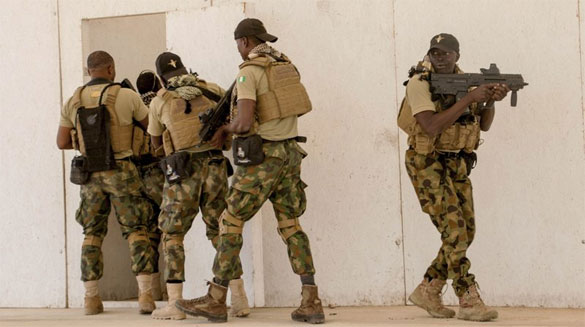 FILE - In this Feb. 18, 2020, file photo, Nigerian Navy Special Boat
Service troops exercise under the supervision of British special forces during
U.S. military-led annual counterterrorism exercise in Thies, Senegal. Both the
Islamic State group and al-Qaida see the global upheaval caused by the new
coronavirus as a threat but also as an opportunity to strike harder than
before, asserting that the virus is punishment for non-Muslims while also
urging followers to repent and take care of themselves. (AP Photo/Cheikh A.T.
Sy, File)
FILE - In this Feb. 18, 2020, file photo, Nigerian Navy Special Boat
Service troops exercise under the supervision of British special forces during
U.S. military-led annual counterterrorism exercise in Thies, Senegal. Both the
Islamic State group and al-Qaida see the global upheaval caused by the new
coronavirus as a threat but also as an opportunity to strike harder than
before, asserting that the virus is punishment for non-Muslims while also
urging followers to repent and take care of themselves. (AP Photo/Cheikh A.T.
Sy, File)
-----
Both the
Islamic State group and al-Qaida see the coronavirus as a threat, but some of
their fighters also see the upheaval from the pandemic as an opportunity to win
over more supporters and strike harder than before.
Messages
from the Islamic extremist groups show concern about the virus mixed with
bravado, asserting that it is punishment for non-Muslims while also urging
followers to repent and take care of themselves.
But in a
sharp commentary in its al-Naba newsletter in mid-March, IS urged followers to
show no mercy and launch attacks in this time of crisis.
In a
commentary Tuesday, the International Crisis Group warned that the pandemic
threatens the global solidarity that is key to fighting extremists.
“It is
almost certainly correct that COVID-19 will handicap domestic security efforts
and international counter-ISIS cooperation, allowing the jihadists to better
prepare spectacular terror attacks,” it said.
Though
analysts said it was too soon to say which attacks can be blamed on militants
exploiting the coronavirus, Islamic extremists in late March carried out their
deadliest assault yet against the military of Chad, a significant contributor
to Africa’s growing counterterrorism efforts, killing at least 92 soldiers near
the border with Nigeria and Niger.
In Egypt,
two military officials reported a spike in IS attacks in March in the restive
northern part of the Sinai Peninsula but security forces foiled at least three
other major assaults. The officials spoke on condition of anonymity because
they were not authorized to brief the media.
While Syria
and Iraq have seen no uptick in attacks by IS since the virus spread there, the
pandemic has prompted the U.S.-led coalition to halt training activities in
Iraq amid a planned pull-out from several bases.
There are
signs elsewhere that the U.S., British and other militaries are pulling back
because of the virus, leaving a possible opening for the extremists.
That’s a
danger in Africa’s hot spots of the Sahel, the Lake Chad region and Somalia,
where the U.S. military already worried allies in recent months by
contemplating cuts to focus on threats from China and Russia.
“Any state
that was interested in pulling back in Africa will take the opportunity to do
so,” said Clionadh Raleigh, executive director of the Armed Conflict Location
& Event Data Project, which tracks extremists’ activities worldwide. “That
will be unbelievably bad.”
A U.S.
Africa Command spokeswoman, Lt. Christina Gibson, told The Associated Press
that “while the size and scope of some AFRICOM activities have been adjusted to
ensure the safety and protection of forces — both U.S. and partner nation — our
commitment to Africa endures.” She did not give details of affected operations
but said AFRICOM still has about 5,200 forces on the continent at any given
time.
The British
army mission in Kenya, which provides counterterrorism training and other
skills, this week announced that all army families are returning to the U.K.
because of the virus.
But
France’s largest overseas military mission, Barkhane in West Africa’s sprawling
Sahel region south of the Sahara Desert, is keeping its 5,100 troops there, the
French Defense Ministry said. A pro-al-Qaida French organization issued a
statement Tuesday urging French forces to stay home and save lives instead.
African
military units, already stretched thin and under attack, are likely to take
protective measures as the virus threatens their ranks.
In Nigeria,
which has struggled against the Boko Haram extremist group and an assertive
IS-linked offshoot, the military has called for suspending much of its
activities including large gatherings and training.
A leaked
memo signed by Nigerian army's policy chief says its vehicles might have to be
used for mass burials or transferring the sick to hospitals as the virus
spreads.
While
security forces are targets, under-guarded prisons could be too, said Laith
Alkhouri, a counterterrorism adviser who researches extremists in West Africa.
Both IS and al-Qaida-linked fighters have turned the Sahel into Africa's most
urgent extremism crisis, and even have engaged in some unprecedented
cooperation.
Their
fighters are likely to exploit the pandemic by accusing governments of
mismanaging the crisis to try to win popular support, he said.
Alkhouri
said that under another scenario, individuals may believe that only religion
can keep them safe from the virus “and ignore scientific advice, which could
lead to an increase in infections.”
Some
extremist groups are showing signs that, like the rest of the world, they are
trying to understand the coronavirus and respond.
In Somalia,
the al-Qaida-linked al-Shabab held a rare five-day meeting of its leaders in
March that discussed the virus. In a communique, the group recognized its
“emergency threat” to the world, including Muslims.
An
al-Shabab spokesman later told the AP it was too soon to comment on whether the
group would heed a U.N. plea to halt attacks, which have continued, or whether
it would allow health workers access to areas it controls.
In
Afghanistan, the Taliban have gone even further, putting out videos on
disinfection and photos of its fighters handing out face masks and soap. It also
has offered security guarantees to any aid group assisting victims of the virus
or helping to stop its spread.
Taliban
spokesman Zabihullah Mujahed told the AP that “if, God forbid, the outbreak
happens in an area where we control the situation, then we can stop fighting in
that area."
Kathy
Gannon in Islamabad, Pakistan; Haruna Umar in Maiduguri, Nigeria; Sam Mednick
in Ouagadougou, Burkina Faso; Abdi Guled and Tom Odula in Nairobi, Kenya; Baba
Ahmed in Bamako, Mali; Samy Magdy and Maamoun Youssef in Cairo; SamyaKullab in
Baghdad and Sylvie Corbet and Angela Charlton in Paris contributed.
Original
Headline: Extremists See Global Chaos
From Virus as an Opportunity
Source: The Associated Press News
URL: https://newageislam.com/radical-islamism-jihad/islamic-extremist-groups-see-global/d/122370
New
Age Islam, Islam Online, Islamic Website, African
Muslim News, Arab
World News, South
Asia News, Indian
Muslim News, World
Muslim News, Women
in Islam, Islamic
Feminism, Arab
Women, Women
In Arab, Islamophobia
in America, Muslim
Women in West, Islam
Women and Feminism