
Pakistan – Radicalisation and Nuclear Vulnerabilities
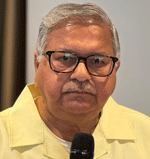
By Sultan Shahin, Founder-Editor, New Age Islam
Introduction
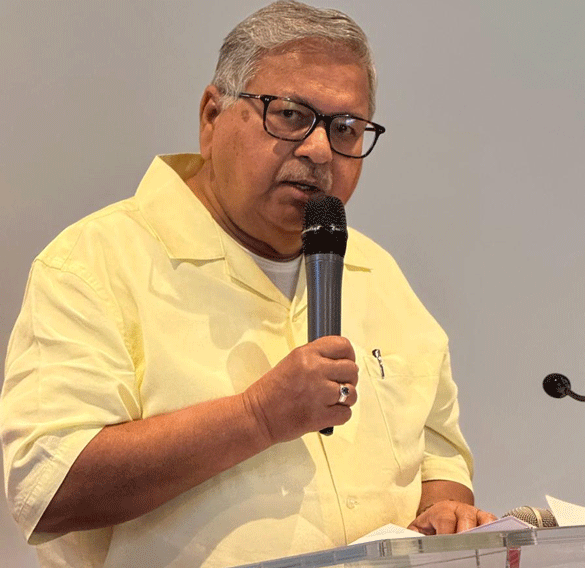
The following is the text of a speech delivered by Mr. Sultan Shahin, Founder-Editor, New Age Islam, at an international book presentation and panel discussion held on 3 July 2026 at Hôtel NVY, Geneva, Switzerland, on the side-lines of UN Human Rights Council's 62nd regular session held in Geneva from June 15 to July 7, 2026. The event was jointly organized by the Centre International de Lutte contre le Terrorisme (CILT) and the New Age Islam Foundation.
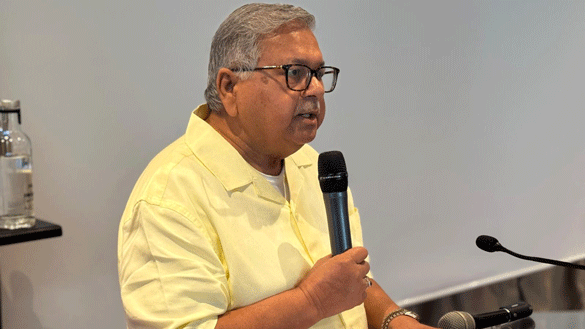
The conference marked the launch of the latest book by renowned journalist, geopolitical analyst, and former head of the Arab-Muslim desk at AFP's diplomatic service, René Naba, Nuclearization of Asia: From Nuclearisation to the Emergence of Asia.
The discussion took place against the backdrop of an increasingly volatile international security environment. The failure of the Eleventh Review Conference of the Nuclear Non-Proliferation Treaty (NPT), the continuing Russia–Ukraine war, renewed military tensions between India and Pakistan following Operation Sindoor, and the recent conflict involving Iran, Israel, and the United States have all intensified global concerns about nuclear security and international peace. The conference also examined the growing influence of artificial intelligence on global geopolitics and its implications for peace, security, and strategic stability.
Drawing upon the themes explored in René Naba's book, Mr. Sultan Shahin addressed one of the most pressing challenges confronting South Asia and the wider international community—the relationship between religious extremism, state-sponsored radicalisation, terrorism, and nuclear security. His speech examined the historical roots of radicalisation in Pakistan, its impact on regional stability, and the urgent need for collective international efforts to prevent extremism from undermining global peace and security.
The full text of Mr. Sultan Shahin's address is reproduced below.
…
Mr. Rene Naba, Dr. Biro Diawara, Other Distinguished delegates, colleagues, and friends,
We meet today in Geneva during the 62nd session of the UN Human Rights Council at a time when the intersection of extremism and nuclear security in Pakistan demands urgent attention. Pakistan’s nuclear arsenal faces vulnerabilities that could ripple far beyond its borders if radicalisation and extremist violence are not contained. There appears to be no signs that this violence can be contained in the near future. Indeed, it is only growing.
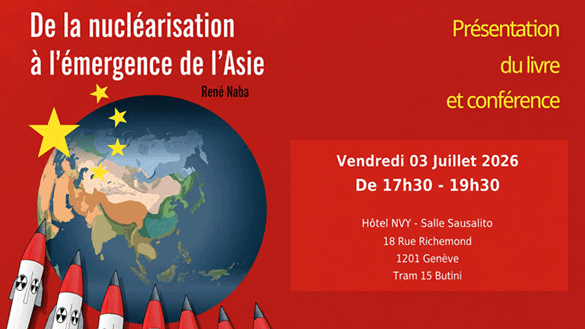
The book Nuclearization of Asia that we are discussing today has clearly come at an opportune time. The author René Naba writes: “While Pakistan claims to have strengthened its nuclear security infrastructure and the US has helped it do so, the growing radicalisation of the masses and perhaps even of Pakistan military personnel, the existence of terrorist groups such as the TTP and return of Taliban regime in Afghanistan have further increased the vulnerability of nuclear infrastructure.”
The author is rightly and clearly pointing to several aspects of the issue that we must discuss here today.
A) The growing radicalisation of the masses in Pakistan.
B) Radicalisation of Pakistan military personnel.
C) The existence of terrorist groups such as the TTP and return of Taliban regime in Afghanistan.
D) The fact that all these have further increased the vulnerability of nuclear infrastructure.
Let us focus on these issues pointed out by the author.
The Radicalisation Challenge
Radicalisation in Pakistan has deep roots. Extremist ideologies have penetrated not only the society but also institutions meant to safeguard the state. The Tehrik-i-Taliban Pakistan (TTP), a violent extremist group responsible for severe harm and loss of life, has exploited grievances, sectarian divides, and weak governance to recruit sympathisers.
Insider radicalisation is the most insidious threat. When individuals within the military or nuclear establishment begin to sympathise with extremist narratives, the danger is not just ideological—it becomes operational. A single compromised officer can open pathways to sabotage, leaks, or even direct facilitation of extremist access to sensitive assets.
TTP Attacks on State Institutions
The TTP has repeatedly demonstrated its capacity to strike at the heart of Pakistan’s state machinery.
- Military bases have been attacked, undermining morale and exposing vulnerabilities.
- Police academies and security installations have been targeted, eroding public trust in the state’s ability to protect its citizens.
- Civilian institutions, including schools and courts, have suffered devastating assaults, spreading fear and destabilisation.
Each attack is not just an isolated tragedy—it is part of a broader strategy to weaken the state, delegitimise its authority, and create openings for extremist influence.
Pakistan’s state—especially under General Zia-ul-Haq—engineered radicalisation as a deliberate tool of foreign policy. By expanding madrassas, embedding jihadist ideology in education, and supporting militant networks, it created the conditions for the rise of the TTP and the spread of extremism within society and even the military.
This was done deliberately to wage proxy wars against India and to secure “strategic depth” in Afghanistan.
The legacy of these policies continues to haunt Pakistan’s internal stability and regional security today.
Key Drivers of State-Sponsored Radicalisation
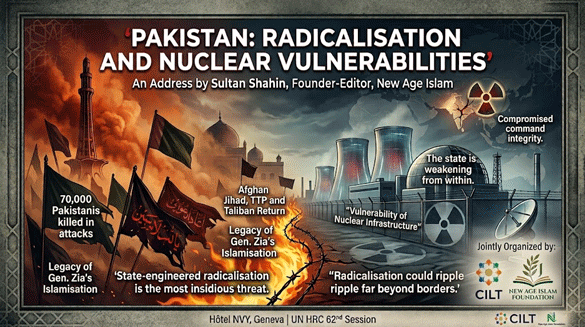
1. Zia-ul-Haq’s Islamisation (1977–1988)
- Legal & Educational Reforms: Zia introduced Hudood Ordinances and reshaped curricula to emphasize jihad and Islamic identity.
- Madrassa Explosion: The number of madrassas rose from 900 in 1971 to over 8,000 registered and 25,000 unregistered by 1988. Most followed the Deobandi tradition, which became the ideological backbone of militant groups. (News18)
- Media Control: State-controlled media propagated a singular religious narrative, embedding radical rhetoric into public discourse. (ojs.pssr.org.pk)
2. Afghan Jihad and U.S.-Saudi Support
- Pakistan, with CIA and Saudi funding, trained and armed tens of thousands of fighters for the Afghan jihad against the Soviets.
- These networks later morphed into the Afghan Taliban and TTP, with Pakistan’s ISI providing sanctuary and logistical support. (FDD's Long War Journal)
3. Proxy War Against India
- Pakistan’s military-intelligence establishment deliberately cultivated jihadist groups to fight in Jammu and Kashmir.
- Fighters trained in madrassas and Afghan camps were redirected toward India, embedding militancy into Pakistan’s security doctrine. (News18)
Consequences
- TTP Emergence: The Tehreek-e-Taliban Pakistan (formed 2007) is a direct byproduct of Pakistan’s earlier jihadist infrastructure.
- Insider Threats: Radicalisation seeped into military ranks, raising concerns about nuclear security.
- Regional Instability: Pakistan’s policies destabilised Afghanistan, worsened Indo-Pak tensions, and created transnational jihadist networks. This policy institutionalised militancy, radicalised society and parts of the military, and eventually backfired with the rise of the TTP.
Key Figures To be Kept in mind in this discourse:
- Madrasas: 900 (1971) → 8,000 registered + 25,000 unregistered (1988).
- Afghan Jihad Fighters: ~80,000 trained with U.S.-Saudi-ISI support.
- TTP Casualties: Over 70,000 Pakistanis killed in terrorist attacks since 2001.
It is important to remember that during the Afghan Jihad (1979–1989), Pakistan’s madrassas became ideological factories for jihadist mobilisation — a transformation engineered by the state under General Zia‑ul‑Haq and fuelled by foreign funding. Their curriculum and messaging were deliberately reshaped to serve geopolitical ends rather than purely religious education.
What Madrassas Taught During the Afghan Jihad
1. Core Ideological Shift
- From theology to militancy: Traditional Islamic jurisprudence and Arabic grammar were replaced or supplemented with lessons glorifying jihad as an armed struggle.
- Deobandi and Ahl‑e‑Hadith influence: These schools emphasised puritanical Islam, rejection of syncretic South Asian traditions, and hostility toward Shia, Sufi, Ahmadi Muslims and all non‑Muslim communities.
- State‑approved jihad narrative: Textbooks described the Soviet invasion as a war against Islam, framing Pakistan as the “fortress of faith.”
2. Curriculum Content
- Textbooks funded by the U.S. and Saudi Arabia (via USAID and the University of Nebraska‑Omaha project) taught mathematics through war imagery — e.g., counting bullets and tanks.
- Religious texts: Works by Abul A‘la Maududi and Ibn Taymiyyah were central, promoting the idea that Islamic governance required struggle against “infidels.”
- Training modules: Many madrassas near Peshawar and Quetta offered basic military drills alongside Quranic recitation.
3. Radicalisation Sources
- Saudi Wahhabi funding: Imported Salafi ideology replaced South Asia’s traditionally pluralistic, Sufi, Barailwi Islam.
- ISI oversight: Pakistan’s intelligence agency vetted madrassa networks to recruit fighters for Afghanistan.
- Clerical networks: Figures like Maulana Sami‑ul‑Haq (Darul Uloom Haqqania) became known as “Father of the Taliban.”
It is important to see what, if anything has changed in madrasa curricula today. Pakistan’s madrasa radicalisation was state‑engineered, foreign‑funded, and ideologically sustained. While insistently claimed reforms have softened some edges, the legacy of General Zia’s jihad curriculum still echoes — producing generations steeped in militant theology rather than civic education.
What Madrassas Teach Today
1. Post‑2001 Reforms
- Pakistan introduced registration and oversight under the Pakistan Madrassa Education Board (PMEB).
- Some madrasas added English, maths, and computer studies, but reforms remain uneven — only about 10–15% madrasas follow modernised curricula.
2. Persistent Ideological Themes
- Many still teach Deobandi or Ahl‑e‑Hadith theology, emphasising strict orthodoxy and rejection of Western secularism.
- Anti‑India, anti‑Shia, anti-Sufi, anti-Ahmadi Salafi rhetoric persists in certain seminaries, especially in Khyber Pakhtunkhwa and southern Punjab.
- TTP‑linked madrassas continue to glorify martyrdom and resistance against the Pakistani state, despite bans.
3. Current Radicalisation Drivers
- Foreign funding from Gulf charities sustains hardline institutions.
- Weak state regulation: Only a fraction of Pakistan’s estimated 30,000–35,000 madrasas are formally registered.
- Socio‑economic appeal: Free lodging, food, and religious legitimacy attract impoverished youth.
The Domino Effect
If unchecked, these dynamics can trigger a cascade:
- Insider radicalisation→ extremist sympathies within nuclear staff.
- Targeted attacks→ public confidence erodes, military overstretched.
- Political destabilisation→ oversight weakens, governance falters.
- Silent infiltration→ extremist networks erode command integrity.
- State capture→ extremists seize nuclear assets, global crisis ensues.
The consequences would be catastrophic: regional war, refugee crises, global energy shocks, and great power confrontation.
International Responses
Global actors escalate their involvement in lockstep with Pakistan’s choices:
- Early action keeps responses technical and diplomatic.
- Weak responses force escalation into sanctions, covert operations, and crisis debates.
- Collapse triggers maximum responses—military mobilisation, UN Chapter VII resolutions, and fractured global governance.
Role of NGOs
For NGOs, the role is vital:
- Advocacy: Push for transparency and accountability in nuclear governance.
- Humanitarian Preparedness: Support refugee response planning.
- Bridge-Building: Encourage cooperation across geopolitical divides.
- Public Awareness: Frame nuclear security as a global public good.
Closing Appeal
Colleagues, the choice before us is stark: resilience or collapse. Resilience requires vigilance, cooperation, and courage. Collapse leads to confrontation, instability, and suffering.
Let us commit, here in Geneva, to ensuring that Pakistan’s nuclear future—and by extension, our shared future—remains secure, stable, and peaceful.
Thank you.
…
New Age Islam, Islam Online, Islamic Website, African Muslim News, Arab World News, South Asia News, Indian Muslim News, World Muslim News, Women in Islam, Islamic Feminism, Arab Women, Women In Arab, Islamophobia in America, Muslim Women in West, Islam Women and Feminism