
Why Muslim Ulema's Condemnation Of Udaipur Killing Is Hypocritical: The Real Culprit Is The Post-Quranic Theology Which Sanctions Beheading For Blasphemy
By
Arshad Alam, New Age Islam
30 June
2022
The
Source Of Such Violence Is Within The Theology; No Aalim Is Willing To Question
It
Main
Points:
1. Terrorism is
designed to disrupt modern civic and national life.
2. Barelwi
radicalization poses a unique risk as they are the largest sect of
subcontinental Muslims.
3. All Muslim
organizations have condemned the gruesome murder.
4. But none of
them have talked about the need to change the theology or weed out Ahadith that
sanction such beheadings.
------
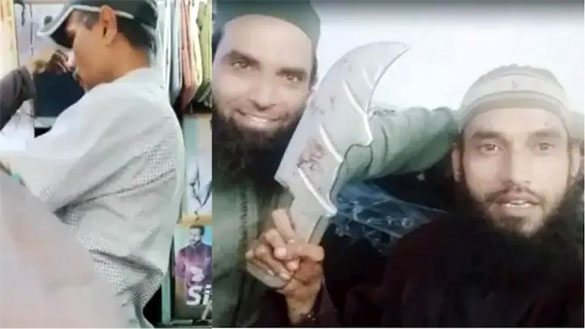
A Hindu shopkeeper (L) was killed in Udaipur by two
men (R) over a social media post in support of Nupur Sharma.
-----
The brutal
killing of Kanhaiya Lal, a tailor, in Udaipur is an act of pure terrorism. The
objective of the execution is to silence all those who have a different point
of view regarding the issue of blasphemy. This terror works to silence not just
Hindus but also those Muslims who have consistently argued that issues like
blasphemy should not have any relevance today. It is a terror act also because
it partakes in the global trend of using brutal violence to kill or maim anyone
who does not believe in maintaining the sanctity of the prophet of Islam.
At many
places, the effect of this terror has been self-censorship or a dire reluctance
to criticize aspects of Islam that one is uncomfortable with. Anyone remotely
interested in the existence of modern nation state needs to speak up against
this. Simply because a civic national life is not possible without the free
exchange of ideas, without a looming threat that one can be killed simply
because of speech.
---------------------------------------------------------------------------------
---------------------------------------------------------------------------------
The video,
self-shot by the killers, shows a determination in carrying on the act. It was
not a spur of the moment decision but a calculated move. In one of the videos,
shot on the 17th June, one of the killers already announces his intention of
avenging the insult to the honour of the prophet. In this video, Feroze Attari
shames the local Muslims for not doing anything while the name of the prophet
is being besmirched. In the second video, which was shot after the murder has
been committed, he along with Muhammad Ghaus, declare proudly that they have
avenged the honour of the prophet and that Muslims elsewhere should follow
suit. They declare their love for the prophet, stating that they live and die
only for his glory and honour.
Muslims
have always regarded the way of the prophet (Sunna) along with the Quran as two
of the most important sources of fashioning a life of piety. Almost all sects
of Islam have high regard for the prophet of Islam.
-------------------------------------------------------------------------------
-------------------------------------------------------------------------------
Over the
years, however, the Barelwis have raised their love of the prophet to an almost
fanatical devotion. The protection of his honour has become the sole politics
through which the Barelwis have been defining themselves in the Indian
subcontinent. The cries of Labbaik Ya Rasul Allah is heard from
Chittagong to Islamabad, with the singular hope that Barelwi power be
recognized as the most important voice of the subcontinental Muslims. And they
do not speak in thin air: they constitute the majority of Muslims in South
Asia, including in India.
Over the
years, they have been side-lined by Deobandis who because of their being more
urbane, were able to access the state and penetrate different institutions
without any resistance. Denied their share in power, the Barelwis of today want
this privilege to be reversed. Their path is to anchor their politics around
the issue of blasphemy, a theological trope which almost all Muslim governments
will find hard to oppose.
Both Feroze
Attari and Muhammad Ghaus belong to the Barelwi sect. It is claimed that one of
them visited Pakistan and was close to the Dawat e Islami, a proselytizing
organization that was set up as a parallel to the Deobandi aligned Tablighi
Jamaat. If true, then it points to a transnational radical linkage which needs
to be thoroughly probed. However, one need not get radicalized by visiting
Pakistan, there is enough material available online through which one can
become self-radicalized. More importantly, the Barelwis in India have been
raising similar slogans in the recent past and it would be worthwhile to
understand what influence this has on the average followers of this sect.
---------------------------------------------------------------------------------
---------------------------------------------------------------------------------
Just
recently, on the 20th of June, a huge rally was organized by Tauqeer Raza, the
Barelwi leader to demand the arrest of Nupur Sharma and the slogans of Labbaik
Ya Rasul Allah were raised in this rally. Those who think that Barelwis are
moderate while Deobandis are the hardliners need to think again. In certain
contexts, even the so-called moderates can become extremists. What is more
worrisome is that this time we are talking about the majority sect within
Muslims wherein even if a small percentage get radicalized, then we will have a
major security issue at hand.
It is
heartening to note that all Muslim organizations have unequivocally condemned
the beheading of Kanhaiya Lal. But much more is expected of them since this
sanctimonious condemnation alone will not do. They have all underlined the fact
that it is illegal and un-Islamic to commit such a murder. They have pointed
out that such a penalty is to be awarded only after a due process. Statements
like these only underline that none of these Muslim organizations condemn the
very idea that blasphemers should be killed. Their only limited criticism is
that the it is the state (secular or Islamic) which is the legitimate locus of
executing this punishment. In other words, Muslim organizations do not have any
problem with the medieval idea that blasphemers should be killed. Almost all of
them have demanded a blasphemy law while at the same time arguing that they
believe in constitutional democracy!
This is
like condemning the fundamentalists without condemning the fundamentals. The
idea of beheading the blasphemer comes from so called sayings of the Prophet or
Hadees. It is not at all a part of the fundamental teachings of Islam. The
Quran not only does not expressly mention it, it teaches patience and
forgiveness to Muslims and gives instances of the name callings and insults and
humiliation the Prophet faced. In fact it says that all prophets had faced
insults and humiliations. The hadiths do call for punishment for blasphemy. The
Islamic sharia, first codified 120 years after the demise of the Prophet, and which
has varied from time to time and place to place, has in some versions upheld
the view that such a punishment should be given to anyone who blasphemes.
Without questioning the corpus of Islamic scripture, it is not possible to have
any informative discussion on the issue.
---------------------------------------------------------------------------------
Also Read: Udaipur Beheading:
Educated Muslims Say Not In My Name
---------------------------------------------------------------------------------
Today there
is a need to say loud and clear that contemporary Islam does not believe in the
idea of blasphemy at all. For this, we have to revisit, challenge and discard a
theology which still sanctions the killing of blasphemers. The responsibility
of doing so rests squarely on the shoulders of Muslim organizations, religious
or otherwise. By dodging the issue, they are doing a great disservice to the
Muslim community and to India.
-----
A
regular contributor to NewAgeIslam.com, Arshad Alam is a writer and researcher
on Islam and Muslims in South Asia.
New Age Islam, Islam Online, Islamic
Website, African
Muslim News, Arab
World News, South
Asia News, Indian
Muslim News, World
Muslim News, Women in Islam, Islamic
Feminism, Arab Women, Women In Arab, Islamophobia
in America, Muslim Women in West, Islam
Women and Feminism