
Though Labels Change, Essence Persists...... 'Evolution' Of Dr Ambedkar's Navayana Buddhism

By Sumit Paul, New Age Islam
22 May 2023
The erudite Mr Ashok Sharma doesn't agree with me that, " Ambedkar's Navayana Buddhism has a
vestigial allegiance to Hinduism." This statement indeed needs a detailed
elaboration.
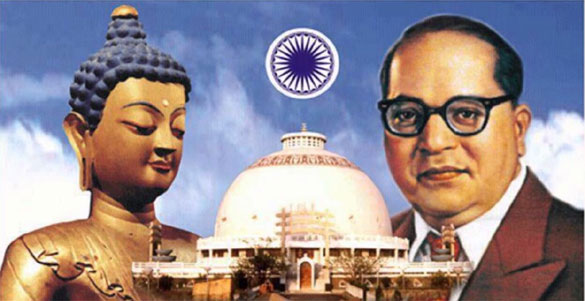
Agreed, Dr Ambedkar propounded and proclaimed his 'New
Vehicle' (Navayana) Buddhism as something unique as he already rejected the Theravada,
Mahayana and Vajrayana traditions of Buddhism as well as Hinduism, but that was
on paper. Mind you, he left Hinduism and adopted Buddhism about six weeks
before his death. He may have completely discarded Hinduism as his 22 vows
categorically suggest. But, could he see the realization of his dream
'project'? Alas, he passed away soon after.
Ambedkar was against deification (a prominent and canonised
attribute of Hinduism) and godhood. Since he was highly educated, he could do
away with the idea of god/s (in the context of Hinduism). But, ironically his
followers deify him and today, he's almost a god to them. So is Buddha who's
called Bhagwan Buddha. What an irony! The man who always flouted god/s and all
esoteric beliefs, himself became a god to his followers.
Religion is an ingrained habit. It's the perpetuation of an
earlier faith into the new one. Vestigial allegiance never goes completely.
Hasn't Islam 'plagiarised' a lot many customs and rituals from Judaism?
Circumcision, Halal (Jews call it Kosher), not eating pork etc.
Early Persian poet Abu Mansur Daqiqi (935 CE-977 CE), who
contributed to Shahnama with his 1, 000 verses, embraced Islam just to
survive. He was a Zoroastrian. He openly showed his allegiance to the earlier
religion he belonged to. Here's the English rendition of his Persian verse:
'Daqiqi has chosen four qualities of all good and evil things in the world:
Ruby-coloured lips and the sound of the lute. Old red wine and the Zoroastrian
religion!'.
It's worthwhile to mention that numerous prominent Iranian
scholars and officials converted to Islam during the early Islamic period in
order to maintain their means of livelihood but practised Zoroastrianism in
secret.
The first poet of modern Persian, Rudaki or Rodaki (880 CE -
941 CE) remained loyal to Zoroastrianism despite embracing Islam. The great
Persian mystic Bayazid Bastami (804 CE - 874 CE) secretly wrote panegyrics on
Zarathustra despite going ga-ga over Muhammad and Allah. His grandfather,
Surooshaan, embraced Islam.
Jainas who call themselves to be a minority are actually
Hindus in disguise. Likewise, Dalits who belonged to Hinduism like Ambedkar
himself, still subconsciously show their allegiance to Hinduism. Since 90 per
cent Ambedkarites are in Maharashtra, people outside the state are not much
aware of this form of Buddhism and how its followers still show a trace of
allegiance to Hinduism, the faith that ill-treated their forefathers on the
basis of class and caste. Many Dalit women still fast during Hindu festivals.
You may call it a convert's dilemma.
Look at the Qaimkhani Muslims (also spelled as Kayamkhani or
Kaimkhani) of the northern belt of India. They still have an emotional
attachment to Hinduism as they came from a Rajput clan (precisely from
Prithviraj Chauhan). So are Mewati Muslims of Delhi, Alwar, Bharatpur and Haryana
(esp. Nuh district). They were also from the Rajput stock. The Muslim
descendants of world's first linguist Panini, who wrote ' Ashtadhyayi,' still
study Sanskrit. They're known as Panini Muslims. The point is: Though labels
change, habits and essence persist.
-----
A regular columnist for
New Age Islam, Sumit Paul is a researcher in comparative religions, with
special reference to Islam. He has contributed articles to the world's premier
publications in several languages including Persian.
URL: https://newageislam.com/spiritual-meditations/evolution-ambedkar-navayana-buddhism/d/129822
New Age Islam, Islam Online, Islamic Website, African Muslim News, Arab World News, South Asia News, Indian Muslim News, World Muslim News, Women in Islam, Islamic Feminism, Arab Women, Women In Arab, Islamophobia in America, Muslim Women in West, Islam Women and Feminism