
The Nellie Massacre of 1983 Killed Thousands in Assam; In the Larger Assamese Society, the Tragedy Is either Underplayed or Justified

By
Jyotirmoy Talukdar
18/FEB/2023
Today,
the Nellie massacre completes 40 years.
On the
morning of February 18, 1983, thousands of Bengal-origin Muslims were massacred
near Nellie in central Assam – not when the night was dark but when the sun was
up. In the larger Assamese society, the tragedy is either underplayed or
justified.
I decided
to approach 13 individuals from the state with one question: is an apology due
for Nellie?
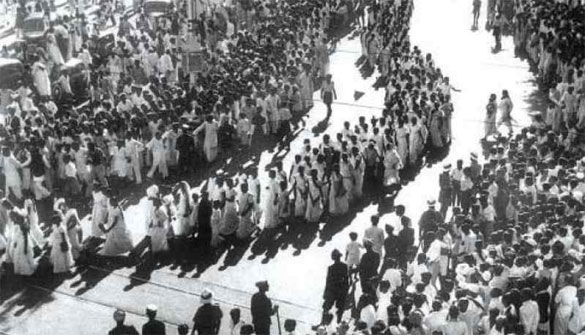
A
rally in the Assam movement. Photo: Wikipedia/CC BY-SA 4.0
------
“I have no
direct answer to the question. Had it been committed by the government, the
answer would have been yes,” says Professor Akhil Ranjan Dutta, a well-known
social scientist in the country who has commented extensively on the region’s
political past and present.
“The Nellie
massacre was the outcome of chauvinism, propaganda and communal hatred. Those
who committed it were also victims of the same ills. Imposing an election in
such an emotionally volatile situation was a mistake on the part of the
government. Will the government tender an apology? Not the incumbent government
as the ruling party was not there during that period. If an apology had to be
tendered, it would have to be by those who led the movement and subsequently
formed the government, to be precise (the ex-chief minister) Prafulla Kumar
Mahanta and his colleagues. Assamese people as a whole are not responsible as
there were divisions within the Assamese society regarding the movement and its
strategies.”
‘Deliberate
Memoricide’
For the
scholar Angshuman Choudhury, though, such an apology should come, first and
foremost, from the Assamese society at large.
“But to
decide who or what the ‘Assamese society’ is can be a complex exercise in
itself. In my view, it is the mainstream Assamese political, intellectual and
cultural class that needs to face the victims of Nellie and apologise for the
unimaginable violence inflicted upon them in the name of protecting their
homeland. This does not, of course, mean that all of those who apologise
directly took part in the violence, but that they were – and continue to be –
active stakeholders of a certain body politic that enabled the violence either
by commission or omission. They also need to apologise for the structural
violence that followed the physical violence of Nellie – the systematic, and
often, deliberate memoricide of the event, the refusal to talk about the
perpetrators, and the pushback against those who tried to talk about the
victims,” says Angshuman, who is an Associate Fellow at the Centre for Policy
Research, New Delhi.
Both he and
Dutta seem to agree on a point regarding the parties that led the governments
in question – Congress at the state and the Union when Nellie happened, and the
Asom Gana Parishad soon after it.
“Many of
the leaders of the Assam Movement are still alive and are members of the
political fraternity and civil society in Assam today. They, especially, need
to participate in this act of apology for allowing the dominant sentiments
within their movement to be violently directed against a vulnerable ethno-religious
minority. I also believe that the Indian state owes an apology to the victims
of Nellie. It needs to apologise for not fully pre-empting the violence and
also, abjectly failing to prevent it. The day’s government – ideally in Assam,
but also in New Delhi – needs to do that on behalf of the state. I also believe
that much like in the case of the 1984 anti-Sikh pogrom, the Congress party,
which was in power in the state and centre at that time, needs to apologise to
the victims of Nellie for not doing enough to save them from the machetes,
arrows and sticks that changed their lives forever. I hope Rahul Gandhi, if and
when he marches into Assam as part of the Bharat Jodo Yatra’s second leg, does
that on his party’s behalf. It would be the morally upright thing to do,”
believes Anghsuman who has regularly written on the state’s ethnic
complexities.
Acknowledgement,
Dialogue, Memorialising
Most of the
people who I spoke to for this article emphasised on the need for
reconciliation rather than an apology.
Aman Wadud,
a human rights lawyer trained in the University of Texas and based in Guwahati,
says, “The only way forward is justice and reconciliation. Not even one person
has been punished for killing thousands of innocent people in Nellie. Although
four decades have passed, there must be an attempt to punish the guilty, only
such an attempt will pave the way for reconciliation.”
Bonojit
Hussain, an independent researcher and activist, feels that the first step for
such an exercise towards ‘truth and reconciliation’ is acknowledgement. “First,
the acknowledgement that so many people were killed will have to come clearly.
After that, the process for a dialogue, a sorsa, can begin. The third point is
to institutionally memorialise the episode,” Hussain listed.
This is an
argument which resonates with the author Mayur Bora. “A fitting memorial must
be built for all the victims,” said Bora adding that they must also be treated
as no less than martyrs.
Sanjoy
Hazarika, who has authored multiple books on the northeast, wondered whether
one can ask the question of apology 40 years later. “A new generation has come
up and people need to live with dignity. It’s not the question of an apology
but acceptance that a terrible thing happened,” Hazarika opined, stressing the
need for counselling so that the affected families can finally lay the
nightmares to rest.
“Their
rights need to be respected and upheld, new livelihoods created, skills taught
as many are still at a subsistence level.”
Larger Implications
Just like
Professor Dutta who was wary that the seeking of an apology will only help
forces who have been propagating a theory of a ‘clash of civilisations’ –
largely implying the BJP government – Professor Hazarika, too, asked, “Would it
not open old wounds?”
Angshuman Sarma,
an academic from Jawaharlal Nehru University and one who has worked closely
with the Bengal-origin Muslims of Assam, also felt that the more urgent need is
to create a space for a heterogeneous and harmonious society where ‘all
communities have a dignified position and collectively work for real social
issues’.
Sarma also
asserted that not all Assamese people were complicit. “There always was a
section of people, cutting across community lines, who not only advocated a
pluralist society but also fought for it and gave their lives. Progressive
people from Assam opposed the semi-fascist nature of the Assam Movement and had
to sacrifice lives for it (including my maternal uncle),” he sighed.
The
political scientist Nani Gopal Mahanta, also the education adviser to the
Himanta Biswa Sarma-led BJP government in Assam, while condemning the massacre,
remarked, “However, during 1983, at the peak of the Assam Agitation, there were
a number of incidents in which people from all walks of life had to pay a heavy
price. Assam is a unique mélange for ethnic mobilisation and identity movements
which are both violent and non-violent. If we make a list of all armed violence
(by ULFA, NDFB, BLT, etc), ethnic violence and ethnic displacement from 1983 to
2011-12, the list will be endless.”
“Who will
forgive whom, who will be forgiven and who craves for forgiveness?” he asked.
Sanjib Pol
Deka, an eminent writer of fiction in Assamese, tends to be of the same mind.
“Firstly,
the killings of Nellie cannot be compared to the massacre of the Sikhs in Delhi
in 1984, nor to that of the Muslims in Gujarat in 2002. Nellie and similar
incidents were not related to the central leadership of the Assam Movement.
Some communal forces with vested interests exploited the sense of insecurity
and fear that had existed in the minds of the local people for 60-65 years
because of unprecedented migration of Muslims from east Bengal to the
Brahmaputra valley in the 1920s and perpetrated incidents like Nellie and
Chaulkhowa. But who attacked the Bodos in Gohpur? What was the role of the
state that imposed an election amid the tensed situation of 1983?” Deka too
asked.
He
maintained that all relevant issues like the suspicious ways of the right-wing,
the role of the regime and the history of migration must be discussed so that
such incidents can be prevented in the future.
‘Moving On’
Mirza
Lutfar Rahman, a radio announcer and a storyteller who belongs to the victims’
community, said that “bhul swikar aru kshama” (conceding and apologising) can
indeed be the right step to accelerate the process of the formation of a larger
Assamese jaati (nation/identity).
Rehna
Sultana, also from the community and an assistant professor of Assamese
literature, minced no words in calling it ‘rather unfortunate in a democratic
country like India’ that no perpetrator was convicted.
But, true
to Sanjoy Hazarika’s observation that some may have ‘tried to move on’, Amin
Nozmul Islam, a young singer, was more irreverent in his take. “I am not
willing to give much importance to the question of apology,” he snapped.
How Will
The Reconciliation Be Realised?
“In a
multiethnic society like Assam, we require a transformative peace building
exercise whereby Track II and Track III civil society initiatives could be
undertaken for reconciliation and the peace process. A process rather than an
event that will focus on listening to each other and carving a space for inter-
and intra-group dialogue is the need of the hour. Even our universities and
colleges could undertake such an exercise,” Mahanta answers.
Dutta, who
recently published the book Hindutva Regime in Assam: Saffron in the Rainbow
said that what one needs to understand is how this process takes place at the
ground level. “How have the two parties – the perpetrators and the victims –
re-built the relationship and how have they been co-habiting despite the
catastrophe of the past?…How are they doing it, and why are they doing it? Meta
narratives should not drive our actions. More than the external agencies, the
wisdom and the aspirations of the people on the ground need to be understood
and respected,” he noted.
Kaustubh
Deka, a university professor of political science, sends his response on the
issue in writing: “For a massacre of the magnitude of Nellie, no apology is
perhaps big enough. People of this land, a section of the ‘Assamese’ to be
precise, have been living under the unbearable weight of this apology for four
decades now, expressed or unexpressed.”
As yet
another February comes and goes, Deka would perhaps agree that this admission
continues to remain more unexpressed than expressed. And that, precisely, is
the lament.
-----
Jyotirmoy
Talukdar is a senior writing fellow at the Centre for Writing and
Communication, Ashoka University.
URL: https://newageislam.com/spiritual-meditations/nellie-massacre-assam-assamese-tragedy-/d/129148
New Age Islam, Islam Online, Islamic Website, African Muslim News, Arab World News, South Asia News, Indian Muslim News, World Muslim News, Women in
Islam, Islamic
Feminism, Arab Women, Women In Arab, Islamophobia
in America, Muslim Women
in West, Islam Women
and Feminism