
Arab States Are No Longer a Single Bloc Opposing Israel but Are Divided into Two Coalitions; One On Iran’s Side And The Other Against It

By Lt. Col. (res.) Dr.
Mordechai Kedar
October 20,
2020
BESA Center Perspectives Paper No. 1,781,
October 20, 2020
For many
years it has been commonly accepted that there is an “Arab world.” That world
had a unifying institution in the Arab League, a leadership body in the Arab
Summit, and a more or less unitary agenda cantered around the desire to see
Israel disappear and a Palestinian state take its place.
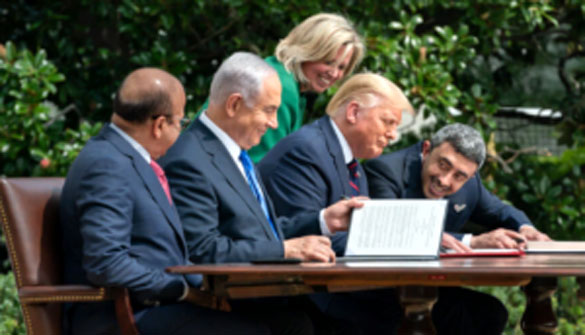
Signing
of the Abraham Accords on the White House Lawn, photo via US Department of
State
------
That last
element now belongs to the past. For several years now, the so-called “Arab
world” has ceased to be what it once was. What exists today are two hostile
coalitions that are fighting one another with great tenacity and no sensitivity
to the casualties being suffered on either side.
One of
these coalitions contains Iran, Iraq, Syria, Lebanon, Yemen, Qatar, and Gaza,
and it is supported from the outside by Turkey, Russia, and China. Against it
stands an opposing coalition made up of Saudi Arabia, the UAE, Bahrain, Egypt,
Jordan, Morocco, Sudan, and Israel, supported from the outside by the US. The
remaining Arab states lie somewhere between the coalitions.
Israel has
been added to Saudi Arabia’s coalition because—and only because—it has proven
in recent years that it is the only country in the world capable of inflicting,
time after time and at an average frequency of once a week, severe blows on an
Iranian force or a pro-Iranian militia in Syria. The Saudi coalition has noted
with interest that with the exception of a single instance, Tehran appears to
be afraid of hitting back at Israel. Israel is thus effectively deterring Iran.
For the
sake of comparison, recall that in September 2019, Iran attacked Saudi
oil-producing facilities and paralyzed a considerable part of the kingdom’s oil
industry. Did we hear about a Saudi response? For that matter, have we heard
about a response by any country to Iran’s attacks on oil tankers in the Persian
Gulf or the Red Sea? Is Riyadh capable of deterring Tehran now that the Saudi
army has failed in its attempt to destroy the Houthis in Yemen?
In the
current situation, with Iran collecting Arab countries like old clothes,
Israel—which in the past was considered “the problem”—has become part of the
solution. It turns out that there are things more important to some countries
than a resolution of “the Palestinian problem.” This means the biggest losers
from the deep division in the Arab world are the Palestinians, and with them
all who believed that Israel would be perceived as the Arabs’ ultimate enemy
until the problem was solved to the Palestinians’ satisfaction. Now that the
“Arab world” as it was once constructed has ceased to exist, the “Israel
problem” has become a thing of the past.
There are
several reasons for the marginalization of the Palestinian issue. The first is
the escalation of the Iranian problem to the level of an existential threat,
while the Israeli-Palestinian problem is not an existential threat to anyone.
The second is Palestinian behavior over the years, and particularly in recent
years. The residents of Saudi Arabia and the UAE well remember that Yasser
Arafat backed Saddam Hussein when the latter took over Kuwait in 1990. The
Saudis are also angry because the Palestinians violated the Mecca Agreement of
February 2007, which was supposed to put an end to the rift between Fatah and
Hamas. (Hamas is an offshoot of the Muslim Brotherhood, the Saudis’ nemesis.)
They are also incensed that the Palestinians are willing to accept aid from
Iran.
Meanwhile,
deep processes are at work. The younger generation of Arabs did not experience
the “Palestinian nakba” and it is not part of their historical memory. The
“Arab Spring,” which precipitated the collapse of regimes and economies and the
rise of the Islamic State, threw millions of Arabs into great distress and mass
emigration for a life of refugee status, poverty, and suffering far from home.
The Palestinians’ belief that those Arabs should fight for the “liberation of
Palestine” is not uppermost among their concerns.
As for
Palestinian conduct, here is an interesting case. One of Israel’s harshest
critics is Jamal Rian, the brain behind Aljazeera and its main newscaster. He
was born in Tulkarem, moved to Jordan, and became a prominent activist in the
Muslim Brotherhood. It was recently revealed that Rian’s father was a land
dealer who, before Israel’s establishment, sold sizable tracts of land to the
Jews. What Arab wants to be a “sucker” and fight Israel to liberate for Jamal
Rian the lands his father sold to Jews, a transaction that did not exactly harm
his son financially?
Another
factor that works against the Palestinian ethos is the huge increase in the use
of social media. Today, any Arab can see the truth about Israel without needing
to rely exclusively on his government’s propaganda outlets for information.
Automatic translation allows him to “read” Hebrew websites even if he does not
understand a word of Hebrew. This makes it much harder for the Palestinians to
keep selling “the problem” the way it used to. Indeed, many Arabs now
intentionally misspell “the problem” in a way that expresses contempt for it.
The Arab
world of 2020 differs from that of 2000 in many ways. It is not the delusional
“new Middle East” envisaged by Shimon Peres but its complete opposite: a region
that is violent, fractured, rife with failed states, and afflicted with mass
killing. But these unfortunate developments work in Israel’s favor. True, there
is still no small hatred among Arabs for Jews and the Jewish state that must be
acknowledged and contended with, and there are still hundreds of thousands of
rockets surrounding and threatening Israel. Nevertheless, the trend is clear.
The peace
and normalization between Israel and the UAE and Bahrain signifies the collapse
of the old theories, enabling the Jewish state to be accepted as a member, not
an enemy, in the “right” coalition.
------
This is an edited version of an article that
appeared in Makor Rishon on October 12.
Lt. Col. (res.) Dr. Mordechai Kedar is a senior
research associate at the Begin-Sadat Center for Strategic Studies. He served
for 25 years in IDF military intelligence specializing in Syria, Arab political
discourse, Arab mass media, Islamic groups, and Israeli Arabs, and is an expert
on the Muslim Brotherhood and other Islamist groups.
Original Headline: No Longer United Against
Israel: The New Arab World
Source: The Begin-Sadat Centre for Strategic Studies
URL: https://newageislam.com/the-war-within-islam/arab-states-no-longer-single/d/123204
New Age Islam, Islam Online, Islamic Website, African
Muslim News, Arab
World News, South
Asia News, Indian
Muslim News, World
Muslim News, Women
in Islam, Islamic
Feminism, Arab
Women, Women
In Arab, Islamophobia
in America, Muslim
Women in West, Islam
Women and Feminism