
The UAE And Bahrain's Peace Overture To Israel: What Message Do The Arabs Convey To Us Muslims?

By Prof. Akhtarul
Wasey, Tr. New Age Islam
(Translated
by New Age Islam Edit Bureau)
17 October
2020
Israel–UAE
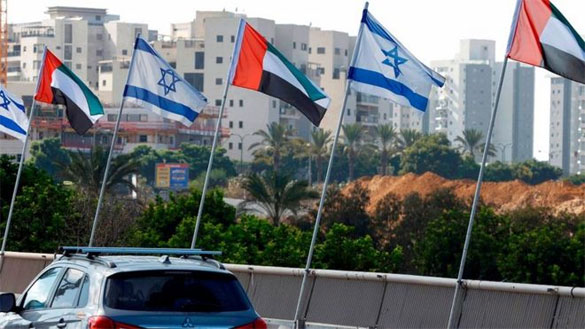
normalization agreement, officially called the ‘Abraham Accords’ have elicited
mixed responses from the global Muslim community with the majority of them
feeling disheartened. They argue that at a critical juncture of unceasing human
rights violations of the Palestinians at the hands of the Israeli forces, the
peace overture from the UAE and Bahrain was uncalled for.
However, if
we look into the shifting historical dynamics of the Palestine-Israel issue,
there seems to be no sense of permanence in this age-old conflict ridden with
international geopolitics and diplomatic dimensions. Since the establishment of
Israel in 1948, the majority of Arab countries have never accepted Israel’s
statehood. However, Egypt in 1978 and Jordan in 1994 gave a nod to the
existence of Israel in a bid to pursue their mutual diplomatic and economic
interests. Thus, the conflict has remained a rather complex and constantly
changing issue in the broader Muslim imagination but it cannot be seen in a
historical vacuum.
Viewed from
a historical perspective, the cordial relations between Jews and Arabs can be
traced back to the advent of Islam. In later periods, especially under the
Abbasid Caliphate, Jews thrived and flourished without confrontation from the
Muslim rulers and jurists. Jews as well as Christians wielded great influence
on the cultural affairs in the Caliphate, especially in Baghdad. Some Abbasid
Caliphs showed wider embrace and great recognition to the Jewish scholars for
their scriptural knowledge and wisdom and manifold intellectual contributions
that ushered in Islam's Golden Age. Notably, during the reign of Caliph
Al-Mansur (714–775)—the third caliphate to succeed Prophet Muhammad (PBUH)—
Jews and Christians actively engaged in Islam’s academic pursuits and
influenced the Muslim way of performing death funeral (Janaza). Most significantly, the Caliph of Baghdad laid the very
first stone for the foundation of the city as the capital of his caliphate with
an input from his advisors including a Jewish astrologer. Later, Caliph
Al-Mutawakkil (822–861) and Al-Muqtadir (908–932) also followed a similar
policy in their treatment with Jews and Christians in their territories. They
recruited Christians as secretaries, and non-Muslims including Jews had access
to the most prominent positions within the dynasty.
An opening
toward negotiations or peace agreements between the leaders within Israel and
Palestine came with Yasser Arafat, the then Palestinian leader and chairman of
the Palestine Liberation Organization. He was the first to realize that the
establishment of Palestinian state was not possible with only forceful
resistance. Subsequently, he initiated normalization negotiations and proposed
the idea of a two-state formula with Israeli leaders in Oslo. Arafat proposed
to offer olives, in place of military arms to move forward towards the desired
peace. Nevertheless, the Oslo talks were no more than an overture to a long
debate, which miserably failed to establish an independent Palestinian state.
Concomitantly, Israel’s continuous tenacity emboldened by the United Nations’
indifference to the human indignities of the Palestinians. The Palestine
Liberation Organization carried forward the legacy of Yasser Arafat even after
him under the leadership of Mahmood Abbas. In the meantime, the US and its
allies declared Jerusalem as the capital of Israel and thus added fuel to fire
in the Palestine crisis.
Now, the
UAE and Bahrain with their peace overture convey the message that the Arabs are
now guided by the principles of pacifism and a radically new non-violence
policy. In their bid to maintain peaceful diplomatic alliances with Israel,
they are read to cut off from the majority of Muslim world who do not extend
open or tacit support. It was the time Israel showed the similar
large-heartedness and a more responsible and humane attitude towards the persecuted
Palestinians.
First and
foremost, Israel should take initiative to return all illegally captured and
forcibly occupied lands since 1967 to Palestinians and Jerusalem should be
restored to the situation as earlier. At the same time, we should not forget
King Salman’s underlying statement that Saudi Arabia will not forge an alliance
with Israel unless the legal rights of Palestinians are accorded to them. Only
then the Abraham Accords will be viewed as a genuine effort towards mutual
reconciliation. Without Saudi Arabia, Israel would not be able to enjoy
the support from the Islamic world
fraternity because King Salman is not only the ruler of Saudi Arabia but also
the custodian of the two holiest sites in Islam—Makkah and Madinah—and thus he
holds the central position for Muslims around the world.
We also
understand that the 21st century Saudi Arabia is on the cusp of change, and is
heading towards new economic, educational and cultural reshape. The Arabs of
the 21st century are no longer the Saudis of the 20th century. Emotions and
aspirations of the new Arab generation are completely different from their
predecessors. Therefore, the Saudis have adapted themselves to the modernity
that has taken place over a period of time in its immediate neighbourhood; Abu
Dhabi, Dubai, Doha and Muscat. One of the encouraging news emanating from the
gulf is that even Qatar is not at the loggerheads with Saudi Arabia with
regards to the agreements with Israel. After a long time, Qatar and Saudi
Arabia are agreeing upon an issue of mutual interest. It was about time that
Turkey and Iran also gave some thought to it.
In all
likelihood, the future course of politics in the Gulf countries will face a
crucial phase. Since the UAE and Bahrain do not share borders with Israel,
therefore, the case now will not turn out to be similar to Egypt and Jordan. If
they remain true to their words, the stabilization agreement will continue to
bear fruits. Or else, it will only reinforce the stand of Turkey and Iran in
the Muslim world and regional and international support for Palestinians will
be amplified.
Without a
doubt, it is an uphill decision taken by the UAE and Bahrain to forge
diplomatic alliances with Israel, but it seems rather more daunting challenge
for Israel because if it fails in the agreement, a far more vociferous global
outcry will humiliate it on international platforms. However, UAE and Bahrain
are likely to be exonerated of any accusations because they will cite the
precedent of Israel cheating on Jordan and Egypt. I personally request King
Salman to play a leading role in maintaining peace and stability in the Gulf
while at the same time safeguarding the rights of Palestinians. Global peace is
ruled out unless there is stability, security and harmony in the Middle East.
In this context, the Abraham Accords are indeed a welcome change in the
positive direction, but only if you do not give Israel an 'open pass'. No peace
agreement is open-ended.
------
Professor Akhtarul Wasey is Professor Emeritus
in Islamic Studies at Jamia Millia Islamia, New Delhi and President, Maulana
Azad University, Jodhpur
The original article was published in Urdu
daily, Inquilab.
URL: https://newageislam.com/the-war-within-islam/the-uae-bahrain-peace-overture/d/123179
New Age Islam, Islam Online, Islamic Website, African
Muslim News, Arab
World News, South
Asia News, Indian
Muslim News, World
Muslim News, Women
in Islam, Islamic
Feminism, Arab
Women, Women
In Arab, Islamophobia
in America, Muslim
Women in West, Islam
Women and Feminism