
A Wake-Up Call for Justice, Humanity, and Reform
By Kaniz Fatma, New Age Islam
06 May 2026
A Mirror to Society: Are We Failing Our Women and Children?
Main Points
1. The alleged abduction and forced marriage of a minor highlights the denial of basic rights and raises serious concerns.
2. Incidents of family violence reveal deep emotional distress and lack of mental health support, emphasizing the need for awareness, counselling, and healthier ways to handle conflict.
3. Women face systemic discrimination in education, work, and social freedom, and true societal progress is impossible without ensuring their equal rights and empowerment.
4. Using religion to justify coercion or injustice distorts its true purpose; the article calls for reform not only in laws but in societal thinking, promoting unity, justice, and human dignity.
-----
Every day, we come across news that shocks us, saddens us, and sometimes leaves us confused. At first, these stories seem unrelated; different places, different people, different situations. But if we pause and reflect, a deeper connection begins to appear. Beneath these separate incidents lies a shared and troubling reality: many people, especially women and children, are still struggling to live with safety, dignity, and a voice of their own.
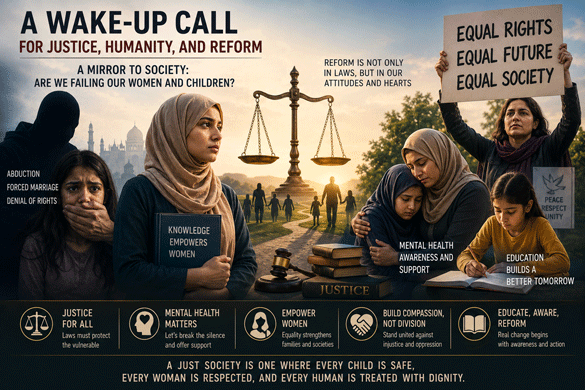
The recent report of a 17-year-old girl in Kaduna—allegedly abducted, forced to change her religion, and married off—is not just one isolated tragedy. It is a mirror reflecting the cracks in our social and moral systems. Alongside other incidents of violence, injustice, and discrimination, it reminds us that reform is not only needed in laws, but in our attitudes, our priorities, and our sense of responsibility toward one another.
When Consent Is Ignored
At the heart of the Kaduna case lies a basic principle: consent. A child is not capable of making life-altering decisions about marriage or religion. If such choices are forced upon her, they are not choices at all—they are violations.
But what makes this situation even more alarming is the reported inaction of authorities. When families seek help, they are not just asking for intervention—they are placing their trust in the system. When that trust is met with silence or delay, it weakens the very foundation of justice.
A society cannot call itself just if it fails to protect those who are most vulnerable. Laws are meaningful only when they are applied with fairness, urgency, and sincerity.
Violence That Begins Within
The report also highlights a painful truth: danger does not always come from outside. Sometimes, it grows within the walls of our own homes.
The incident in Karnataka, where a father allegedly killed his children before taking his own life, is not just a crime—it is a sign of deep emotional collapse. Similarly, the case in Hyderabad reflects how unresolved anger and conflict can turn into irreversible tragedy.
These incidents force us to think beyond blame and punishment. They push us to ask why people reach such breaking points. In many cases, the answer lies in silent suffering—stress, insecurity, emotional pain, and the absence of support.
We live in a world where people are often taught to hide their struggles rather than express them. This silence can be dangerous. True reform must include creating spaces where people can seek help without fear or shame, and where emotional well-being is taken as seriously as physical safety.
The Unequal Burden on Women
Across these reports, one truth stands out clearly: women continue to face the greatest challenges.
Whether it is denial of education, restrictions on work, or constant judgment over personal choices, women are often placed under stricter control than men. In some societies, even their voices—through journalism or public expression—are limited or silenced.
This is not just a women’s issue; it is a societal issue. When half of a population is restricted, the entire society loses its potential. Progress, peace, and development are not possible without equality.
Empowering women does not weaken society—it strengthens it. It leads to better families, stronger communities, and a more balanced world.
The Misuse of Religion
The Kaduna case also brings attention to a sensitive but important issue: the misuse of religion.
Faith, at its core, is meant to guide, inspire, and bring peace. It is a matter of personal belief, not force. When religion is used to justify coercion, it loses its true meaning.
No religion teaches injustice or compulsion. Acts of forced conversion or manipulation carried out in the name of faith are not expressions of religion—they are distortions of it.
At the same time, such incidents must not become reasons for division or hatred between communities. Instead, they should remind us of our shared responsibility to stand for justice, regardless of differences in belief.
Finding Light in Darkness
Amid these painful stories, there are also moments that remind us of humanity’s strength.
The story of a man risking his life to save his sister from a fire shows that courage and selflessness still exist. The efforts of activists and social workers who continue to fight for justice and equality also offer hope.
These stories matter because they show us what is possible. They remind us that even in difficult times, people can choose compassion over cruelty.
Justice Must Be Equal for All
The tragic case of a young girl in London, where legal proceedings were revisited, highlights another important lesson: justice must be fair, transparent, and consistent.
People must believe that the law works for everyone equally. When decisions are unclear or seem unfair, it creates doubt and mistrust.
Justice is not just about punishing the guilty—it is about ensuring that truth is respected and that every voice is heard.
The Path Toward Change
If we truly want to build a better society, change must begin at multiple levels:
Laws must be enforced properly, especially to protect children and vulnerable individuals.
Education must go beyond textbooks and teach values like empathy, respect, and responsibility.
Mental health must be openly discussed and supported.
Women must be given equal rights, opportunities, and respect in all areas of life.
Communities must stand united against injustice, rather than divided by identity.
Real change does not happen overnight. It begins with awareness, grows through dialogue, and strengthens with action.
A Final Reflection
These stories are not just passing headlines—they are reminders. Reminders of the gaps in our systems, the weaknesses in our thinking, and the responsibilities we often overlook.
We cannot afford to simply read and move on. We must reflect, question, and act.
What kind of society do we want to build?
A truly just society is one where every child feels safe, every woman is respected, and every individual is treated with dignity. It is a society where laws protect, communities support, and humanity comes before all divisions.
Reform is not only the duty of governments or institutions—it is a shared responsibility. It begins with how we think, how we treat others, and how we respond to injustice.
Only when we choose awareness over ignorance, compassion over indifference, and courage over silence can we move toward a world that is not only more just, but more human.
----------
Kaniz Fatma is an Islamic scholar (Alimah & Fazilah) and a regular columnist for New Age Islam.
URL: https://newageislam.com/islam-human-rights/wake-up-call-for-justice-humanity-reform/d/139919
New Age Islam, Islam Online, Islamic Website, African Muslim News, Arab World News, South Asia News, Indian Muslim News, World Muslim News, Women in Islam, Islamic Feminism, Arab Women, Women In Arab, Islamophobia in America, Muslim Women in West, Islam Women and Feminism